27 February 2006

Talk at the British Library

The British Library is just round the corner from work - it's so easy to drop in to an event, and at the moment there's an exhibition called "Beautiful Minds" about Nobel prize winners (which I haven't seen). In connection with this, they've got scientists etc doing talks, and this is Kathy Sykes, whose academic and popularising concern is making science accessible. Her (physics) PhD was on PHB, a biodegradable plastic obtained from the "fat" in bacteria. It raised a lot of ethical issues: "How can people trust scientists if they won't talk about ethics," she asked. Indeed. The discussion touched on creativity, explaining science to "naive" adults, researchers vs educationalists in academia, and politicians.

Her first impression of science? Her father was a physicist; her mother knew about atoms, and that's how it started, a question to her mother and an explanation that aroused her curiosity.

16 February 2006

April showers

In February! The hailstorm was brief, but saves me watering the windowboxes this week. Within minutes the sky was clear, the black clouds heading off southeast.

15 February 2006

1952

Oma and her sisters - Dora, Anna, Margarete. The shadow is the photographer. This was taken just before we left Germany. Oma was 66. Though she never went back, she spent a lot of time looking at her collection of photographs.

1910

Oma's wedding. She (Margarete Friedrich) was born in 1888 - June 28. Don't know when Opa (Martin Schleicher) was born. The three girls are her sisters Dora, Leni, and Anna. Her Mother, Luise, is on the left. Opa's parents, Katarine and Nikolaus, are on either side of the couple. Others, from left to right, are Emma Niebling, Johann Niebling, Frau Bargon and her sister Paula Kohl, Baerbel Seifert (sister of Johann Niebling), Peter Seifert. Peter was Martins best friend, and Buergermeister of Gersfeld until the Nazis came to power.

Blue bag, red bag

Gabrielle shared her pattern for a zip-top bag with the members of the UKSewing group. I made it slightly deeper, in a remnant of corduroy found at John Lewis (cost, £2.71), a recycled zip, and lining left over from the coat. What makes the difference with the bag is that it's got quilt wadding under the fabric. And a stiffener in the bottom. Turned out the corduroy was stretch cord. Because of what this does to the handles, I call this my bungie bag.

Another remnant - this one cost £5 - and a brand new zip - and voila, another bag. This one is wider, to show off the pattern.
The zips need a pull - plenty of decorative/imaginative possibilities here. And the inside needs lots of pockets --

Ghastly sweater?

A "bargain" in Whistles sale! Sleeves and back are orange, fronts are brown, embroidery is fuchsia, pink, brown, cream. Sounds ghastly, indeed; looks unpromising in this scan; but it works, in a decidedly boho way, when worn. Maybe not such a bargain - this embroidery is hand done, and the worker no doubt got paid very little. But that little may have made a big difference to the worker's family. This ethical debate has raged elsewhere.

06 February 2006

Chinese poetry

During February, Chinese Poems on the Underground is a counterpart to British poems on the Shanghai Metro. Four poems appear - by Anonymous, 1st century AD; Li Bai (AD 701-761); Po-Chu-i (AD 772-846); and Lu Xun (1881-1936). Posters were available at the British Library's evening of Chinese poetry. I'll put them up in the hall, eventually.


Qu Lei Lei, an artist who's been living in London for the past 20 years and did the calligraphy on the posters, whizzed through 4000 years of Chinese writing in about 15 minutes, but could obviously have gone on much longer. This is an early example of official script - very clear quality of line.This example is later, expressive of the character of the writer. Possibly this was the one who changed sides to preserve his life, and rose to a high position under the new emperor. The music included cello solo from the film Hidden Dragon, Crouching Tiger, and Benjamin Britten's Songs from the Chinese (tenor accompanied by guitar), as well as an arrangement for guitar of "Yi Dance", originally for pipa, played by Xuefei Yang: The pleated fabric of her trousers brought to mind the folds in the dresses of Tang ladies -- and when she lifted her foot to keep time in some parts of the piece, it looked like she might be wearing their shoes with the turned-up toes:
Taking Leave of a Friend - by Li Bai

(translated by Ezra Pound - of whom Piers Plowright, one of the readers, said: he didn't know much Chinese, but he had an instinct for getting the meaning)

Blue mountains to the north of the walls,
White river winding about them;
Here we must make separation
And go out through a thousand miles of dead grass.

Mind like a floating wide cloud,
Sunset like the parting of old acquaintances
Who bow over their clasped hands at a distance.
Our horses neigh to each other as we are departing.

03 February 2006

Button box

These are just the bigger buttons, one of several tins full. Some of these buttons come from a collection found in a charity shop; they might date to the 30s and 40s.

2006 annual snowstorm reunion

Meeting for a drink after work turned into monthly meetings at each others' homes. We started calling ourselves the senoritas after a particularly memorable evening at Mary's shortly after her return from Mexico, when she started the evening with margaritas. Followed by rather a lot of wine...

Three years ago it snowed on the day of our January meeting but we thought nothing of it and the evening passed pleasantly. When Julia phoned to check where her taxi might be, she was told he'd be along in about two hours - because of the snow. So Linda offered to drive Julia and Mary to the tube station, but as they got to Highgate Hill and saw the cars sliding all over the place it was obvious that this was not a good idea. They turned round and went to Linda's and stayed there overnight - she's always prepared for the unexpected!

This year, Mary emailed earlier in the day to say it was snowing in Oxford -- but only a flake or two fell in London. The menu was a salad with roasted almonds and quails' eggs; the roast squash, feta, and rocket penne; and a spanish almond cake, served with creme fraiche; then, chocolates. The weather remained cold, but dry.
Preheat oven to 200C(400F). Place cubes of butternut squash (recipe said 1.2kg but just under 1kg made lots) in a roasting tin with 1 tsp (or more) fresh rosemary, 4 cloves crushed garlic, 1 Tbsp olive oil ; toss to coat. Bake for 30 min, or until squash is soft and golden. Season.

Meanwhile, cook 500g penne until al dente. Drain, return to the pan and stir in 20g butter. Keep warm.

Heat 1 Tbsp olive oil in a frying pan over medium heat; add 1 large red onion, sliced, and cook for 3-5 minutes, then add 1 Tbsp honey and ook for 2 mins or until the onion starts to caramelise. Add 1/2 cup (125ml) chicken or veg stock and simmer gently for 5-7 min or until reduced slightly.

Add the roast squash to the onion mixture, stir to combine, then add to the pasta with 200g feta, crumbled, and 100g resh rocket leaves. Toss to combine and season to taste. Garnish with shaved parmesan.

01 February 2006

Circle game

Below, in lurid closeup, is the (stalled, unfinished) outcome of the "playground for stitches" workshop last month. We cut shapes out of two layers of fabric, then cut them and interchanged the pieces; laid them on a background, and started handstitching with embroidery threads. Okay, I have three fabrics ... it did look perfectly fine with just the dark and the light green, but I'd brought along the medium green and decided to break away from the instructions. Adding the stitches was fun, something to do while watching telly - and it did change the look of the piece considerably - but I'm tempted to say the whole thing is pointless.

This is definitely not a direction I want to go. Too chaotic, without careful choices of stitch and colours. And I did find that "more is better" - add enough, and it starts to harmonise. The principle of repetitive cumulation.

What surprised me was the way the largescale dark print and the light green (a splodgy background printed with tiny gold spirals) could work together. These were "any old" fabrics grabbed from the drawer - those lists of materials to bring to the workshop are frustratingly open to a wide range of interpretation. By now I'm getting used to the challenge and surprises arising from never having brought quite the right thing.So rather than put a nice neat narrow ribbon round my "baseball" to finish it off, I'm going to recycle bits of it as greeting cards -- some day.

However the overlapping areas of fabric, and the idea of interchange (like in central asian felt rugs) did inspire me, so I used the same fabrics and took this idea forward in another exercise. There was enough fabric for four circles - which became six moons rising over the mountain landscape.

In my enthusiasm to finish the exercise I didn't really consider the scientific principles of the dark and light sides of the moon, but that adds a certain enigma (perhaps). It's pinned up on the wall, for now, to torment me. The "japanese feel" of the piece ties in with the current large project, the quilt using japanese fabric.
The quilting was done in long wavy lines, with the straight-stitch foot on the machine. Easier than free-motion quilting, in many ways: fewer options for which direction to go next; machine takes care of stitch length; ease of moving fabric through the machine. It makes a nice dense (or even stiff) fabric. I also like the way the lines make for "flow."

31 January 2006

Happy cups

You do the dishes and never notice what you're doing -- but seeing my favourite cups together like this, I thought how jolly they looked. Like friends at a tea party. Every one has a story -- the painted ones are from Cosmo Place Studio, just down the road from work - have had those since the late 80s - they remind me of Ruth and of Vicky. The blue one from Halifax, the brown one from Plymouth - bringing to mind Rita and Erika. People who couldn't be further apart, geographically.

Chinese new year

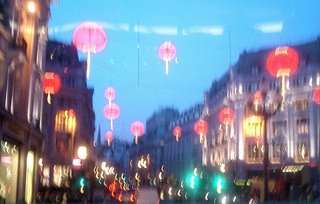
What a nice surprise -- to celebrate Chinese new year, Oxford Circus took down the xmas lights and put up red lanterns. I barely had time to get out the camera as the bus swung round the corner.

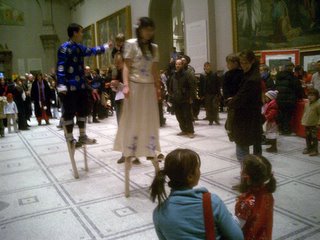
On Sunday we went to the V&A and encountered ... just about any Chinese cultural activity you can think of. The joint was jumping! Stilt walkers...
Calligraphy demonstrations (long queue of people waiting to get their name written in Chinese)... Traditional music...
Drumming and dancing...
Vegetable carving...Chinese chess, mah jong, people in costume wandering around... and everyone was taking photographs, of course. A calligraphy exhibition...
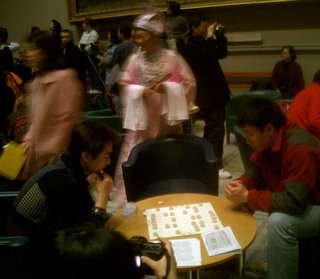
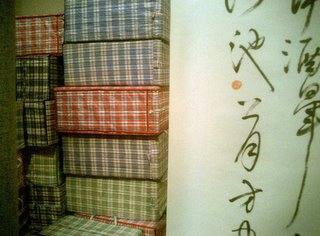
And behind the scenes, a reminder of the preparation and organisation needed for such an event.

27 January 2006

Arctic clothing

The British Museum has published a book on Arctic clothing and had an event to publicise it. I've been intrigued by the sealgut "raincoats" - usually they're sewn in horizontal strips, but here's a pic of a different style, from the Bering Strait area (not from the British Museum's collection).

Inuit technology and resourcefulness are amazing. Darwinism in action.

The speakers highlighted the dangers of the arctic environment and how clothing, especially the boots, had to be perfect in all respects, otherwise the life of the wearer is at risk. Wet is one of the great dangers. Heat is seen as a fluid to be trapped round the body - yet the clothing must be loose so that excess heat can be released. Skin from caribou killed in the autumn, when the winter coat is growing in and is still short, is the best material and traditional clothes consist of one layer worn hair in, another worn hair outward. Even now a caribou layer is worn under modern clothes in cold weather.

The caribou parka that was on display comes from the handling collection. It was shedding a bit, but beautifully sewn. In fact the sewing skill is what gives these garments prestige value. Another type of prestige value comes from the materials used. The Greenland costume that sat on the stage was made in the 1930s for the daughter of the Danish high commissioner, and had a bead collar about three times as deep as even a high-status local would have. The central strips on the trousers are made up of tiny squares of coloured skin, and the high leggings are adorned with lace and flowers cross-stitched in pastel colours. People seized on new materials as they became available, brought in from Denmark (with its tradition of cross-stitch flower embroidery) in this case.
The programme included a film made in the late 1950s among the Netsilik Inuit, just filming with no commentary - or subtitles. Apparently the film was made without sound, then years later shown to the people who were in it, and they could remember what they had said, so that was recorded and dubbed.

This was at a time when Inuit (or Eskimos, in those pre-PC days) culture was on the cusp of being "modernised." Several families agreed to live in the traditional way for a year and allow filming - an early "1900s House." Apparently there was a lot of dispute about the editing and distribution, and eventually the National Film Board of Canada took it over.

The film showed the making of an igloo (deft cuts with snow knife) and a sledge (frozen caribou skin used to make the runners, with moss and ice to make it go smoothly, as well as cutting out a parka and mealtime. There are a dozen of these 20-30 minute films. Fascinating.

24 January 2006

Missoni

This amazing piece of "wearable art", a Missoni coat, is in the V&A's costume gallery. Missoni is a husband and wife team whose trademark is fabulous knits in unique patterns, often zigzag stripes - they started 50 years ago and have passed the business to their daughter, according to a quick skim of Google (isn't the internet educational?).
Only for the brave, is my opinion. But I've been enjoying my new Missoni bath towel, spotted at John Lewis's sale, thanks to an idea planted by Sally as we walked over there after work one evening.

21 January 2006

Abstract art, australian

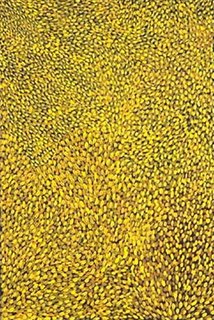
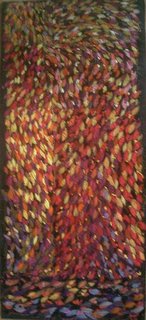
Currently on show nearby, but about to end, some Australian Aboriginal paintings, including this one by Kathleen Petyarr. It's large, a least 1.20 metres wide, and could well inspire a quilt.

The show also has work by Gloria Petyarr. This painting inspired my applique piece "Blown Away":
Blown Away consists of hundreds of thumbnail-sized leaf shapes. The image was once on the website of the magazine Art and Australia in an article about "bush gardens", and I used it for the second "analyse a painting" challenge on AQL (was that in 2002?) - we found a painting we liked, wrote an analysis, posted it to the group, then made a quilt based on it. Some quilts got finished, some didn't, but it was an interesting exercise. Blown Away is made in seven sections, using slightly different combinations of fabric:Gloria Petyarre's works on show at the October gallery continue with the "leaf" them. She worked in the medium of batik between 1977 and 1987; it would be interesting to use the memory of her paintings as a starting-point for batik...

But back to the paintings. Those in the display in the October Gallery look wonderful together and on the white walls. I think that to people outside Aboriginal culture, these paintings are largely enjoyed for their attractive patterning. We don't have the insider knowledge of the subject, and like anyone outside the artist's clan, are not allowed to know -- the right to paint a certain dreaming passes through the family, and though some parts are allowed to be explained to outsiders, much is not. So these paintings have to "work" on another level, fitting in with an individual's or a culture's sensibilities.

Essentially, I like the way those many dots, or strokes, build up into a bigger idea. The power of repetition and cumulation. And the power of work that emerges when people start with, and concentrate on, something so basic to their lives and that they know really well.

20 January 2006

How do we do it? - crocheting

It was a sunny-ish day and not all that cold, so Liane and I sat in Queen Square and undid her bad crocheting habits. What actually happens when we do something as "simple" as crocheting - hook in one hand, wool in the other, use hook to slip wool through loop, again and again - nothing could be easier, right?

As you can see, we found the process tense and anguishing. It definitely needed concentration.


Here are some components of crocheting:

-wrapping the wool around the fingers to control the tension
-length of wool available between finger and loop, controlled by index finger on left hand
-does the hook grab the wool from in front or behind (less movement is best)
-which fingers, and on which hand, hold the work
-how is the hook held - like a pen for writing, or a brush for painting at arm's length
-does the index finger on the right hand hold the loop when the hook isn't passing wool through it
-what stitch are you meant to do next - ch. or s.c. or d.c. or t.c.

Liane is left-handed but was crocheting right-handed. (I tried crocheting left-handed. Needs practice...) She was using cotton and it was difficult to keep the tension because the cotton didn't slip easily around the fingers; later, she reported that it all went much more easily after switching to wool.

Wonderful stuff, wool.

And that little crochet hook has a lot of potential, too. More than just doilies! Take afghan stitch (tunisian crochet) - looks more like weaving than crochet. Here are basic instructions: <http://vickisdesigns.tripod.com/basics.htm>, and this site shows how to change colours: <http://home.comcast.net/~crochet_cindy/tutorial/afghan.htm>

Here's looking at you

On the left, the old pair - my "librarian glasses". On the right, my "web designer glasses".

Combined cost? £1100. But that works out at less than the cost of a cup of coffee a day. And I couldn't be without them.

In taking the photograph, I discovered another use for a digital camera: it lets us myopics see the world clearly without glasses!

19 January 2006

Japanese fabric

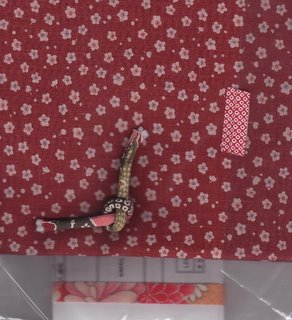
The fabric I ordered on Saturday arrived on Wednesday, all the way from Japan. A surprisingly small envelope, containing 10 pieces, mostly half-yards, of various prints.

What was delightful was the little details - the shibori-dots print tape used to seal the plastic bag, the printed ribbon around the invoice, and the 5" length of chirimen cord, knotted.


18 January 2006

Orange wrappers

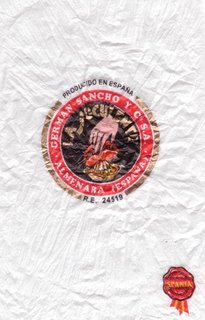
"In Italy, until a short while ago ... for oranges there was a very thin paper printed with the growers' trademarks, which were always figures of heroes from a long popular dream: lions, tigers, Garibaldi Aida, Othello, the occasional special dragon, gigantic snakes, sometimes even printed in gold."

Reading that in the catalogue to the Francesco Clemente exhibition at the Royal Academy in 1992 got me looking at orange wrappers.


There were lots of orange wrappers around, then. Most came from Spain.
I ate SO many oranges. It was a healthy time.
And people, hearing of my obsession, would look for orange wrappers when they went travelling, and send them to me. I smoothed them out and stored them carefully.
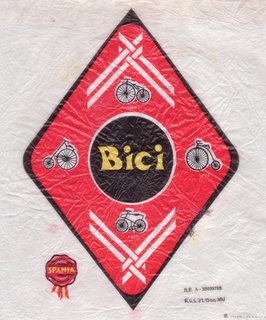
Sometimes I stroked and counted them. 200 ... 300 ... different ones.
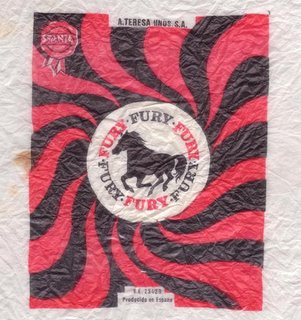
I've lost count now. They're languishing in the back of a cupboard.
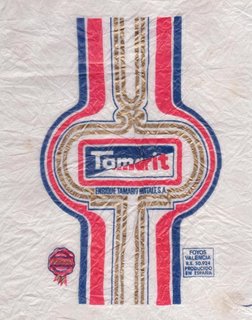
But now, you hardly ever see them any more.