Look behind the label

Labels: objects, unexpected things
Mainly photos of and thoughts about my mixed media textile art ... but sometimes other bits of "life" get in the way
and this is what came out - the largest dimension might be 16cm -
Some of my favourites - the tin glaze makes a nice caramel edge -
This slab was rolled out on a textured cloth, dark glaze (tenmoku I think) brushed on and sponged off, then applied to the textured side, and the slab rolled up a bit -
More dabbing on of glaze and sponging off - with transparent glaze on top of it all -
Pinch pots with different clays inside and out, the one on the left painted inside with tin glaze; the one on the right had the bottom dipped and some glaze dribbled -
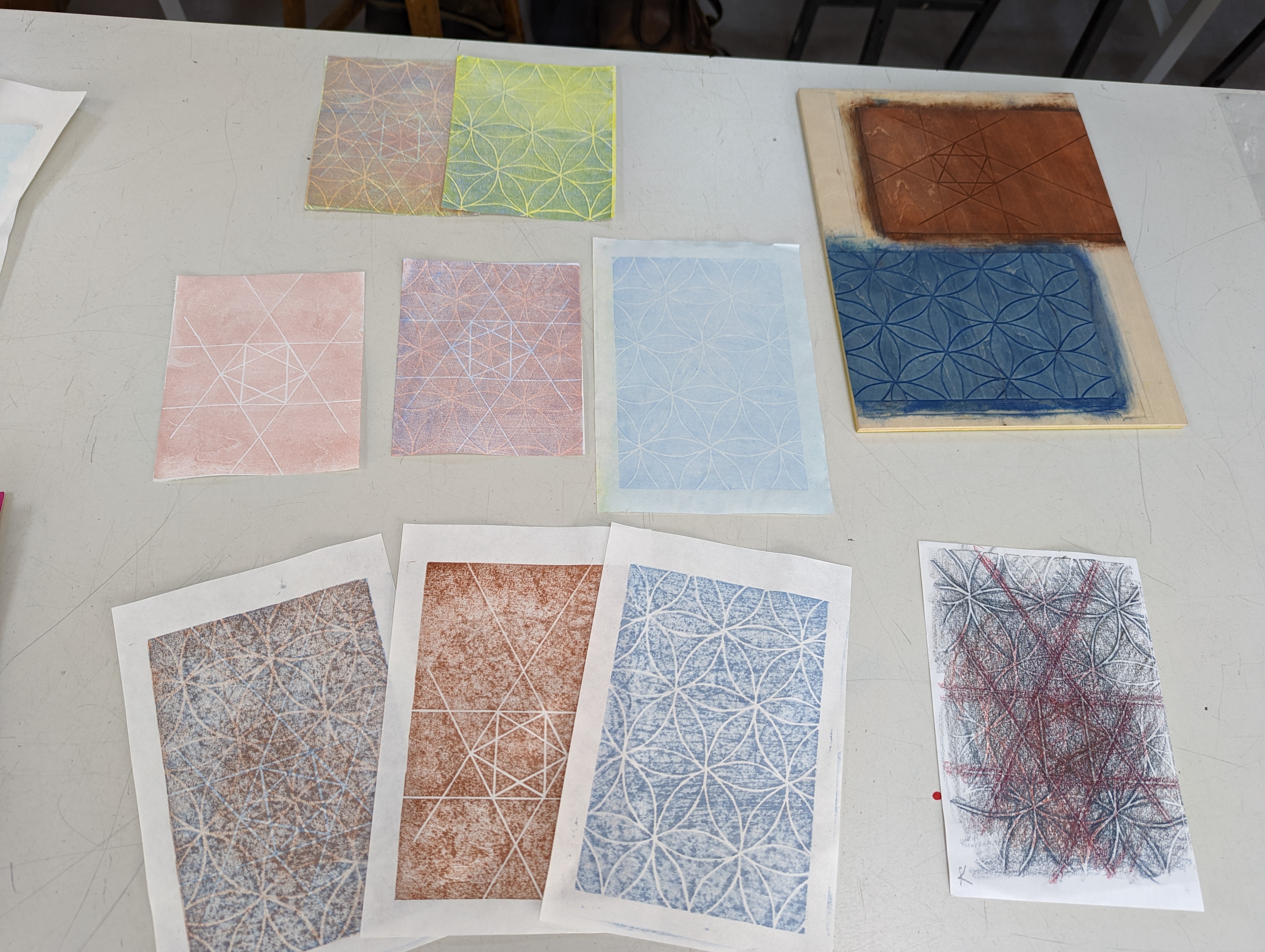
I was aiming to make textures on slabs and by chance discovered that you could print with the wet clay, if only onto the bench -
So, why not paint the slab with slip, and print with that -- and then roll it out a bit more to distort it slightly -
This biscuit-fired bowl got slip painted on and then sponged off -
Another aim was to make some holes -
Here's what's going for biscuit firing - plain and using black slip -
The glossy snakey bits got discarded. The pinch pots have velvet black glaze and are going into the stoneware kiln.
Up to the 1950s, trams ran underground here -
This is what it looks like now -
complete with props left over from filming -
Photos of the artwork itself weren't permitted - here are a couple of publicity shots -
And my photo of the shadow of the twisting rope -
On the way out, this little pueblo of bricks is being stored in a niche -
Back to daylight -
Shawcross says this rope line is a way of understanding time - a metaphor for defining what time is - the rope swaps space for time. He uses an aesthetic of functionality. A similar work in 2003, The Nervous System (a "periously rickety" feat of "simplistic complexity"), also "wove" a rope -
On his later projects he's worked with an engineer. One such is the Space Trumpet, in the atrium of a corporate building - it moves to a new position at midday and is based on early devices used for listening for airplanes -
See more of his work here.Labels: artists, exhibitions, London
After that there was lots of information about choosing and using various types of wood - things I didn't learn at my father's knee (he was building houses after all, not making sculpture).
and here's "15 pairs of hands" - it was interesting to realise that the plinths would have to be metal, and weighted, to support the cast bronze -
Then, to work on our "outdoor project" - I'm still changing mine. I'd brought in some samples of handmade paper joined with microtags
and other more ambitious shapes and sizes, waxed for durability and luminosity -
all working towards the idea of a "house on stilts" - I'm still obsessed by the idea of using non-alphabetic languages, and ladders, but had a little sidetracking into houses on stilts (and igloos!) being places of safety as well as places to meet and communicate
While building a couple of examples, I came up with various things that might be used as legs - pencils, saw blades, paintbrushes, drinking straws, nails, plastic flowers (eg long stemmed roses) - and started thinking about how the qualities of materials, such as the bendiness of tracing paper that's been rolled up, might be used -
Here's the latest development -
But this one (which I prepared earlier) is something to work on another time -
Mary Miss (Perimeters/Pavilions/Decoys, 1977-8) -
Maya Lin's wave fields (video here) -
hmm, bit of a pause now ... no others come to mind ... bear with me while I do some research...
Agnes Denes (Wheatfield - A Confrontation, 1982) - here's the 2009 version in London -
Alice Aycock, with her "unerring ability to convey contradictory notions within a single sculpture" (NY Times, 1990). Her early proposals for earthworks are body-sized and body-related, and many of her early works paly upon fears and fantasies of burial. "Low Building with Dirt Roof for Mary" (1973) can only be entered by crawling; she wrote that "The sense of claustrophobia inside is increased by the knowledge that the exterior surface of the roof is covered by a mound of earth ([weighing] approximately 7 tons)."
Cuban artist Ana Mendieta and her "earth body art" (using body to direct our attention not only to the landscape itself, but also to how it is experienced) -
perhaps even Tacita Dean in her "Search for the Spiral Jetty" 1997 - one of a number of recent artists who have embraced the making of journeys as part of their practice - inspired by the way in which the siting of works in remote locations brought the journey to see them into the compass of the work (I'm quoting from Ben Tufnell's "Land Art", Tate Publishing 2006).
The research also turned up some "land art"/"ecological art" sites in South Africa, and an Australian artist, Andrew Rogers, whose “Rhythms of Life” project is said to be the largest contemporary land-art undertaking in the world, consisting of geoglyphs (stone sculptures) in 12 sites around the globe -My topic is: "The land is not the setting for the work, but part of the work – Walter De Maria, land artist. Discuss the role of context/location in relation to historical and contemporary art or design practice, referring to at least three examples.
At least three examples, and up to six. So, in as-they-came-to-me order: 1, Walter De Maria’s Lightning Field (New Mexico).
2, Dani Karavan’s Ma’alot (Cologne).
3, Richard Long’s mud paintings, for example the Heaven and Earth trigrams in the first room of the recent show at the Tate. 
4, something by David Nash – maybe his wooden boulder -
And passing reference to Robert Smithson’s non-sites, James Turrell’s Sky Spaces, Chris Drury’s work (the dew ponds?), maybe even Andy Goldsworthy and Christo.
5, perhaps Claudi Casanovas’ Els Vencuts – no, too much of a historical monument – could you argue that it commemorates local heroes, hence that a sense of locality and history is part of, necessary to, the work? You could say that of Maya Lin’s Vietnam memorial too – how does commemoration fit together with “the land” – can “the land” be a mental place, a shared history rather than a mapped or perceived geographical place? That’s going a bit deep for 2500 words – and why don’t I just take the easier, straight-forward route...
I’ll be touching on the idea of siting sculpture (rather than memorial objects) outside – especially in sculpture parks; of secular pilgrimage; and the origins of “land art” in that tumultuous time, the late 60s. (I was there! – but just waking up to art, via reproductions of Chagall in the area of the university library where I went to study. Nearby, though (in Vancouver), Robert Smithson was doing a Glue Pour.)
Process, materials, minimalism, these will get a mention.
That’s the plan. Coming soon – more information on the artists. But first I have to go clean the fridge, scrub the oven with a toothbrush, that kind of thing ...
Labels: artists, courses, history, land art, landscape, works in progress
So - you'll have to imagine the fireworks in the dark space at centre top, above the grocery store (open till 11pm) and beside the flats over the betting shop (which has its sign lit up all night!). So nice to live on a lively street.Labels: everyday life, London
And sending off the photos, as well as the 20cm fabric sample -
Getting the colour right on the photos was ... suboptimal. Never mind, it's gone to meet its fate. On to the next thing.Labels: "breakthrough" challenge, small quilts
Annabel is spurring me on. She's in the midst of making numerous books. But I'm not competitive, oh no ... not at the moment ...
They're wasp nests made by three different species in Brazil. Here's a closeup -
Local wasp nests aren't so grand, but do have an interesting structure. On the isle of Skye, wasps build their nests in the heather, as shown here.Labels: wonderful things
The topics/starting points in my group were: gestures (women abstracted from famous paintings); mapping memories; received ideas; bioluminescence; comics. Helen took notes on all of them -
Also helpful was explaining yet again what it is you think you might be doing - "I know what I think when I hear myself talk". My "imagined interiors" (not "imaginARY"!) are quite difficult to explain. Partly because they are mysterious to me, I can't put into words what it "is" about them - which means, I don't know what I'm thinking! Not sure if this state of confusion is a good starting point for a coherent project. It's certainly something to struggle with; isn't struggle supposed to be a vital component of art?
I'm going to be translating these onto clay for textures, eventually. It was a peaceful, restful (somewhat pointless??) thing to do, while the tutors were having one-to-ones. My own one-to-one identified the need to consider scale, the possibility of illusion, the idea of a labyrinth (not excited by that...), and whether the finished form could be common objects with non-visual dimensions. I'm letting all that slush around in the subconscious.
and this is yet another worksheet - the project keeps evolving. It's time to actually make it -
After class, meeting Lisa in a pub on Great James Street, in the 18th-century district near Grays Inn Road - you may have seen it in Brideshead Revisited?
and to a talk about the Chord artwork. The talk was held in the Camden Local History Archive in the library on Theobald's road - a great resource!Labels: courses, drawing etc, London
The Daimler corporation (they make Mercedes cars) has lots of art in their various buildings; this gallery is open 11-6 daily, with free entry. The collection specialises in 20th century abstract art. The Drawing Sculpture show presents a selection of works on paper, about 60 works by 28 artists dating from about 1960, "staging dialogues between classical Minimalist positions from the 1960s and international contemporary art" (says the leaflet).
In "the lawn from behind", use of thread (stitching) is entirely appropriate - everyone handling a piece of embroidery automatically turns it over, and here the artist has anticipated that - and made you think about the grass growing, probably?
Another great thing about this exhibition was the labels - an informative, readable paragraph (in English as well as German); I photographed them to re-read and think about later. Photography, without flash, was permitted.
These works "which she started in 2000, are based on a different way of handling the human body's volumes and outlines. The Scherenschnitte start y measuring the circumference of parts of the body, and these are also listed in the title of each particular work. The number of individual body part measurements fixes the number of strips of paper to be arranged one behind the other. The circumference measurements then define a circle. Reiner calls these circles 'first circles'; they are cut out of the pieces of paper. A mathematical formula then produces a meanvalue for other circles, and cuts are made in the paper on this basis. Thus three-dimensional, irregular body forms are reduced to a disciplining and exemplary system. Reiner's morphometrics exist on the narrow ridge of two-dimensional drawing and three-dimensional relief. The absence of real physical volume creates the mutually involved presence of body and space - via the views into the holes and the realtionsip of the paper layers to the architecture surrounding them."
In the background is Georg Herold's "Ohne Titel" (2002) - "one of a series of showcases in which Herold places all kinds of objects like balloons or technical devices. Load and support of the simply made work are so finely balanced that the shelves and contents, despite that rough material quality, seem very fragile. The grouping of the pumice stones follows the physical laws of gravity, friction and elasticity. The material form captures an element of movement, and also includes an imaginary sequence of events in space and time. "Gebogene Latte V sets higherto unsolved problems of virtual representation to work in a highly coarsened form. The media mix makes it a hybrid, 'coarse-grained' object, whose origins got lost in the zero gravity space of a monitor surface [Bildschirmoberflaeche]."
The label says: "Claude Horstmann's working material is language. She collects words from newspapers and magazines, when travelling by bus or from conversations, and then works them into new, independent texts and represents them visually through the medium of drawing. Horstmann's inspiration for Dark Text was the little slips of paper in Asian fortune cookies, where she was particularly interested in the interface between widespread objectivity and sudden subjectivity. "Everyone knows that it is pure chance what sentence you find in these cookies, but everyone hopes at the same time that they will contain a grain of personal truth. I am interested in the moment when the text opens up this field of ways of reading lying between objectivity and subjectivity, between common property and something special. The aspect of relativity is particuarly relevant to the question of when and how a sentence becomes meanningful or not." (Claude Horstmann) The sentences crossed through with a broad, black paintbrush illustrate these two planes: the text is concealed, like its meaning, which has to be discovered individually."
Here we learn that in 1972 "Marcia was drawing vertical pencil marks, as a kind of meditative exercise into standard black drawing books. She started at the upper left corner and worked systematically down the paper. Then she began to use words instead of lines, but words semantically unrelated to each other. She tried not to make sentences or phrases, used no punctuation, left no margin, line breaks were contingent on reaching the right hand edge of the page. You saw a wall of penciled words."Labels: artists, exhibitions
The urns are made from a conglomeration of clays of different colours, formed around a "nucleus" and dampened into a block 25-40 cm in size. After firing, the blocks are divided in the middle with a hammer and chisel,exposing the empty nucleus within.
He says: "I imagine them all together in a space in nature, as if from an ongoing archaeological excavation"; his ambition for them is "to make you disregard beauty and give meaning to life."
Textile artist Sew Lawty finds "raw physicality and yet stillness in his work - read more of her thoughts on it here.
He has also made etchings - this one is 60cm wide, others are up to 2m wide -
Etching plus block, from a show in Denmark -
It's a felt necklace - aren't the radishes gorgeous? Discovered at the "at work gallery" near Tate Britain. They have gorgeous jewellery, precious and non-precious (ie made from plastic, cloth, etc and/or recycled objects) - see it on their website.
Next door, Long & Ryle were showing work by Xavier Garces - the drawing of the field of stones in the middle of this photo was quite wonderful (priced at £3000) -
We decided we needed to go to the bead shop in Covent Garden, and as we wandered around Sue spotted this lamp stump
which led to discoveries of others, including this Edwardian(?) lamp post that has been replaced by something "more efficient" -
Covent Garden has lots of shops, of course, and as darkness fell we wandered in and out of them. I was aghast at the price of kids' shoes - £24 for these tiny trendies -
Labels: everyday life, London, objects
Here is an essay from the catalogue of her 2003 exhibition. Here we learn that in 1972 "Marcia was drawing vertical pencil marks, as a kind of meditative exercise into standard black drawing books. She started at the upper left corner and worked systematically down the paper. Then she began to use words instead of lines, but words semantically unrelated to each other. She tried not to make sentences or phrases, used no punctuation, left no margin, line breaks were contingent on reaching the right hand edge of the page. You saw a wall of penciled words." At this time, conceptualists and minimalists had the idea that painting was no longer valid.
An essay from Artforum, Sept 1978, on the current state of painting, can be found here. It says that Marcia Hafif: "keeps work whole and within the vision of one author, rarely using an assistant, ordering work form a factory or working in a group. Painting has been able to gather new energy by throwing things out and starting afresh. Although much of it has seemed to continue reduction, it has been, more precisely, involved in a deconstruction, an analysis of painting itself. With belief remaining in the potentialities of abstraction, and in reaction to the apparent exhaustion of painting, the artists cited above, and others, began the inventory - the cataloguing, the examination - of the parts I have spoken of. Painting became demonstrative, conceptual, a thing to be examined, more passive that it had been. The artist was making personal work. Thus certain changes came about. The format became generally smaller. Color became opaque, seen for itself rather than being used t create an illusion or to express. Line was used for itself rather than to delineate shape or form. Personal touch was readmitted as the sign of the brush and the artist's hand was again visible. These are elements of painting. "
"In his typical manner, light and shade activate the area of the enormous nails , thus creating a field of powerful motion, which changes according to the perspective. The intensity of the process of creation endures in the work. The subtle choppiness of the surface makes for a conflictive relationship to the material’s rigidity." says this site.
Neither of these images is "Wind", which is a two-panel painting, the nails with large flat heads daubed with white paint, the background painted pale and darker cream. The nails undulate in height and in angle; the shadows of the nails add to the effect of movement.Labels: artists
bodies strewn everywhere
scene of chaos
and mutilation
Damaged dummies
awaiting their fate
When do the lights go off?
When does this end?Labels: objects, unexpected things
The sign on the wall commemorates the 26 people who died and the 150 who were injured when a V-1 flying bomb destroyed Highbury Corner in 1944.
I'm amazed to see that it used to have trolley buses going round - in the early 1960s.
But enough of this local lore - two minutes' walk and you get to an "Italianate villa" converted into a museum/gallery (with bookshop and cafe). The ceramics are in two rooms, with lovely views to the autumnal scene outside -
I immediately got out my sketchbook - or would have, had it been in my bag. Instead, I had to use pages of the diary. You can see many of the pots in the show here. But not the one that most fascinated me, a "black box with bits" by Guiseppe Spagnulo. On the right, by an amazing coincidence, is my quick sketch/aide-memoire of a textured pot by Pompeo Pianezolla - on the actual day, 1 October, I was in the Kunstgewerbemuseum in Berlin drawing, among other things, other pots by him (though not the one shown in this post).
Spagnulo also did "Testa" -
The arrangement of three pots by Fausto Melotti appealed to me - and indeed he's done a lot of figurative work, and had a retrospective in New York last year.
This tiny picture gives you some idea of the glazes Melloti uses -
It's called Emmons Avenue and it's by Uruguayan-born Antonioo Frasconi, who lives in Connecticut. You can see more of his work here, and I found out about him via the blog of woodcut artist Annie Bissett - in the sidebar you'll find a long list of "other woodblock artists".Labels: artists
The fibres are scooped out of the bucket ("sieve, don't squeeze") and poured onto a plaster slab, covered with fabric - the plaster takes out the moisture.
The pulp is mixed with porcelain powder - or rather, the powder is mixed in water first, then the pulp is added. Various proportions can give different results - but we don't have firsthand experience of this (yet?). Then the mixture is poured into plaster moulds to remove the moisture - it takes a couple of hours to get the clay to a workable consistency.
Meanwhile we searched the shelves for the items from last week that had been fired.
I was pleased with the textures inside this one -
I painted various glazes onto some of the pieces in my tray, ready for stoneware firing: tenmoku (brown), charcoal, and tin glaze (white), as well as some black slip, coating insides and outsides, and filling in the embossed bits -
Wonder what will happen with these pinch pot "barnacles", made in the first week -
Here they all are, ready for firing. (Note the sgraffito!)
As I write, it is "reading week" - a chance to catch up, and to start serious work on "the essay". I've got a bit behind with downloading photos and writing about classes - back to normal next week!
Other artists mentioned in regard to consumer culture were Andy Warhol, Jeff Koons, Takashi Murakami, Michael Landy, Tomoko Takahashi, Tim Noble & Sue Webster, and Damien Hirst. Recommended watching: The Mona Lisa Curse by Robert Hughes (partly available on youtube).


Artists connected with Fischl are David Salle, Alex Katz, Manet, and Frans Hals. Recommended reading: TS Eliot's 1919 essay, Tradition and the Individual Talent.
was about architect Renzo Piano -with special attention to his "ship building" - the science museum in Amsterdam - which is meant to be a mirror image of the tunnel underneath. Note the colour, which helps it to blend in to the environment (imagine what it would look like in orange...)
The Centre Culturel Jean-Marie Tjibaou in New Caledonia is amazing too - its form is similar to the villages in which the Kanak people, whose culture it preserves, live -
The other presentation was about sculptor Eva Hesse
who was working in the context of minimalism and heavy steel sculptures - exploring materials such as direct use of latex; process driven. Subtle and understated work. She said she wanted to "get to non-art ... another kind of vision". The Tate has five works of hers, including "Tomorrow's Apples" -
Shortly before her early death, she described her subject as "the total absurdity of life".
until chunks break off
That looked easy enough, but goodness what a mess it made - and it took quite a long time.
After careful removal of as much plaster as possible comes the scrubbing. I'm going to have to get a long thin pointy thing to get the green plaster out of the keyhole -
After cleanup and mopping of the floor, with people walking over it the whole time, we got back from the lunch break to find it had dried in a wild way -
The afternoon was spent developing our ideas for the sculptures that will go at the front of the building. I got diverted onto a new idea
but really should stick with the original one -
it will give me more focus, and a way to integrate the sculpture and ceramics elements. Gotta think ahead to that final project....