22 January 2009

Tuesday class, week 3

The Natural History Museum was full of classes of students of all ages, from 5-year-olds up -
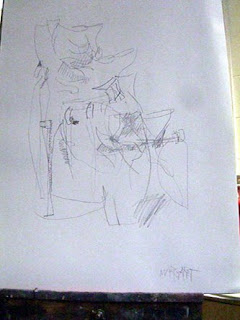
We went to look at structures that allow movement - bones - and spent the day drawing. We were told the snake skeleton was mere repetition and "too simple" -
So, why not draw a whale? -
I found myself in a dim corner of the Birds section, where there are still some delightfully old-fashioned cases. They explained things thoroughly in those days - Did you know that birds can have spurs and claws on their wings?
The raven wingbones I drew had neither claws nor spurs -
And after a close look at an emu's foot, I wandered off to find the sabre-tooth cat (now extinct) -
Next week we'll be making a structure that can move in a predetermined way.

18 January 2009

Wednesday class, week 2

It's about tone - first, a demo of how to build up tone -
We'd all brought an object to draw, but didn't realise we'd be spending the entire day making the one drawing, in our choice of colour(s).
My bowl of rocks might not have been the best choice. I got confused between the pattern on the rocks and shells (and bowl) and using tone to make them look like 3D objects. And the shape of the bowl was somewhat challenging ... but carefully carefully it proceeded -
By afternoon tea break I was ready to try again, to start all over again from scratch, and to more boldly go -
Half an hour later we put our work up on the wall - what variety!
Next week we bring in all sorts of "materials". Something surprising is bound to happen.

17 January 2009

Drawing, week 2

Starting with two basic shapes, adding another, and another, to fill the sheet of paper... We get into groups and talk about them, select our "favourites", then use the awareness of shapes to do an elevation of an object (an electric pencil sharpener in this case) -
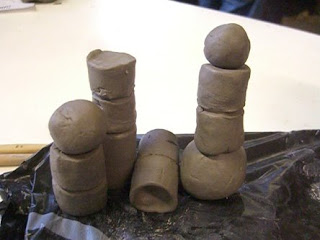
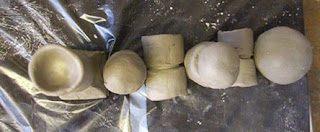
After lunch, back to those basic shapes - they become 3D and we have to arrange them somehow -
Going round the group, with everyone saying what size these would be, and what materials and colours they would be. From the way the clay behaves when it rolls into cylinders (the ends sink in) I see these as beads made in glass or resin, crackled inside but smooth outside, the different thicknesses giving it degrees of opacity.
Homework is drawings that will develop our ideas. We photograph our bits of clay and destroy them.

Here's a closeup of that wire-dipped-in-paper-pulp bird that sits in the tree outside the building -

12 January 2009

Underground


Art heros - Rosalie Gascoigne


Even though she's one of my art heros, I don't know much about Rosalie Gascoigne and have seen her work only on the internet. It would be great to pop over to Melbourne before 15 March and catch her big show there, but I just can't fit it in....! Seeing lots of her work here gets me itching to be making, rather than looking.

10 January 2009

Drawing day

The art foundation course at City Lit is arranged to have two intakes a year - the September lot have a term off while the January lot start. (Everyone attends in the April-July term, and the subsequent two terms.) For each intake, there are two groups, a Tues-Weds group and a Weds-Fri group. On Weds the two groups meet - and the room gets crowded.

On the first day of the "drawing" course, the subject was bags.
First exercise was to cover the centre of the paper with a sheet of newsprint, and draw underneath - without looking at the drawing - for 10 minutes. Very liberating!! Also this introduced the concept of "the performance of drawing" - keeping going longer than you want to ...
After these intense 10 minutes we turned the easels round into the centre of the room and walked around looking at everyone's work. Interesting results!
There was such a forest of easels that there had to be a satellite table for some of the group -
Next exercise involved using different media for 10 minutes each - keeping going for that length of time, and making different kinds of lines.

My first choice, among the pencil crayons, was the light brown - using flowing lines. Then, felt tip (grey) using angular lines, "drawing from the bone". Everyone got a thicker black felt tip and we were told to use curved lines. Then came the (red) ink, and we could use any sort of line - this is where I struggled.
The bag on the right started as a series of dabs with the end of the brush, which took about 3 minutes. What to do for the rest of the time? Also, this "sketchbook page" was looking unbalanced, so I put in the red bag on the left, this time really loading the brush with ink. The lines flowed on in a different way than the scruffy dabs on the other bag, and the excess ink pooled within the lines. Yes! - leave well enough alone ... still 4 long minutes to go ... back to the first bag, going over the lines with a loaded brush - eek a drip, so messy - no, "go with the flow", let's have more of those drips -- they were surprisingly hard to engineer.
The final 10 mins were for "adding anything you want" - so I had a closer look at the actual bag I'd quickly drawn on the bottom, and found that its blackness was made up of at least half a dozen different textures. You can use up a lot of time adding textures ...
Out on the street, the bird continues to perch in its tree -

06 January 2009

Back to "school"

Back at the City Lit - to start the Art Foundation course. A chance to try out new things. I've been looking forward to this for months.
After the "health and safety" intro, it was down to work. Some mark making - texture - the object unseen, just felt. (But it was obviously a couple of thin green pot-scrubber "sponges".) The various media were variously challenging.
Out to lunch - to see this sculptural bird in the tree round the corner -
Did I mention that Tuesdays this term we're doing sculpture? This is the sculpture room - lots of new-to-me stuff -
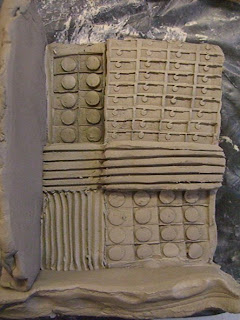
But a lot of 2D is involved as well. Some more texture - enlargement of small objects. The screwdriver at the bottom does look more like bamboo -
Last task, at the end of the day - make a clay mold for a plaster cast; here it is half finished. I tried to remember that what goes down will be up ... but it will be a surprise to unmold the plaster next week.
A pencil sharpener, and a bit of wire that was on the floor, were useful here.

04 January 2009

Structured procrastination

Author practices jumping rope with seaweed while work awaits.

If you think procrastination is a bad thing, think again. John Perry (author of brilliant essays defending life choices generally seen as faults – such as perfectionism ) will reassure you otherwise:

“All procrastinators put off things they have to do. Structured procrastination is the art of making this bad trait work for you. The key idea is that procrastinating does not mean doing absolutely nothing. Procrastinators seldom do absolutely nothing; they do marginally useful things, like gardening or sharpening pencils or making a diagram of how they will reorganize their files when they get around to it. Why does the procrastinator do these things? Because they are a way of not doing something more important. If all the procrastinator had left to do was to sharpen some pencils, no force on earth could get him do it. However, the procrastinator can be motivated to do difficult, timely and important tasks, as long as these tasks are a way of not doing something more important.”

Get the Tshirt, bag, cap, apron, mug…. Or, put that off while you do something less important ….

03 January 2009

A better idea

Never mind the “to-do” lists – how about an “I did it!” list? Here are instructions for making a journal cover out of “chalkboard” fabric. You might not want to specially get the special fabric, but a little book listing accomplishments is a really good idea – especially for those dark moments of the soul
when you wonder what it’s all about, and why you bother, and nobody appreciates or understands you…
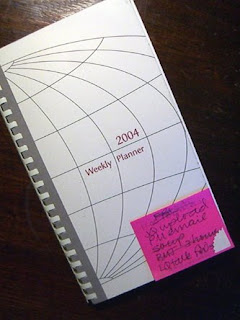
This is a great use for the 2004 diary that I’d planned to use this year – Jan 1 was on a Thursday in both years, after all – but I’d not remembered that 2004 was a leap year, so for 10 months of the year the 2004 diary will be one day out – which could get seriously confusing and counterproductive. However it will make a great “I did it!” book – an ideal home for the tiny post-it notes that list my three (or so) goals for each day. It has those nice little corners that you tear off so you can get to the current page easily.
Making the cover [see top picture] wasn’t on today’s list, but thanks to the magic of fusible webbing took mere moments -- 27 minutes, including putting things away afterward. A necessary distraction! I used the tidy method that Linda shows here.

Tulips

Early on, my tulip cushion was in a Cloth & Stitch show -- in 1993 - right beside this piece by Louise Baldwin, one of my textile heroes - she was stitching onto brown paper, crumpled and painted -
That's a hard act to follow, but here's the tulip cusion, silks applied to velvet:
And a detail. I loved every step of making this cushion; so much careful stitching -
Ten years later, more tulips, in the form of a book cover -
and a detail, showing the hasty construction -

02 January 2009

New Year treat

An oasis of calm -- or rather, of cakes -- amid the insanity of sales shopping.
Mocha and more at Caffe Concerto; "baroque" deco --, and music videos playing (quietly) on tv screens in the corners of the room. Hmm.

Baroque cake constructions, too -

Misunderstanding Barnett Newman

When the Tate had a show of Barnett Newman's work a few years ago (2002), I went away shaking my head. Big canvases, fields of solid colours, vertical lines... it didn't seem quite "enough", somehow.

But something must have been taking root in the subconscious. At home, happening on a few short bits of narrow ribbon and some silk samples, I came up with these:
I enjoyed combining the colours and adding variety with quilting, but of course they're a million miles away from Newman's "biomorphical abstractions" - the "zips" of coloured lines that emphasised the flatness of the surface; colour field painting.

'Newman termed the blank canvas on which he worked "the void." In a sense, that void is Newman's achievement. It appears to derive from a considered decision to redefine painting as an act sufficient unto itself without reference to tradition, history, or nature.'

Newman said: "There is no such thing as a good painting about nothing." He was aiming at the "pure idea" of an art expressing the "mystery of sublime" rather than the "beautiful".

Found photos

At the V&A, during renovations.