13 January 2010

Ceramics week 2

To start with, I got out all my work in progress and had a long look, analysing the surfaces and thinking about the idea behind it. The "corners of rooms" could be lined up in sequence,to make a corridor. A corridor could be made of other materials, too (something to think about in sculpture class tomorrow) -
The safety/danger dichotomy is still calling out to me, supplanting the theme of doors and thresholds. We have a couple of weeks before the Statement of Intent has to be finalised ... it could go back and forth a few times till then.
Halfway down the long room, Robert was demonstrating extrusion and adding handles -
With a mirror you can quickly make an "in between" space -- something to keep in mind when planning the actual exhibition -
These bits & bobs are an assortment of ... what ... something trying to happen -
Probably because it was the path of least resistance, I made yet more corners, thinking of glazing them next week, bypassing the bisque firing -
These corners and doors are waiting for bisque firing -
As are these corners, studded with different types of nails and other hardware -
And finally (from magazine reading), this mixed media piece by Christine McArthur is called Hans Coper's Dream and was exhibited in 2002. We spent some time this morning going through old copies of Ceramics Review and pointing out exciting, or relevant, work to each other - I was pleased to find "a quilt".
Another inspiration are these boxes by Philomena Prestell, also from that 2002 magazine -
Interesting to see how artists' work changes over the years; have a look at her current work.

Next week, glazing - and weeding out.

Abandonned

Seen on the way home. Did someone step into the car, and out of their shoes? How different it is to see two lost shoes, rather than one.

Core studies, week 2

My task for the day (self-imposed): to fill the sketchbook with drawings based on the photos taken in Sculpture class last week. First make the sketchbook - this consists of half a sheet of A1 paper, two strips glued together.The bit of paper at top left, filled in by the tutor, indicates that you've had a discussion that day, and records what was talked about and actions to take. (They have to do rather more record-keeping and documentation than we do.)

By mid-afternoon the little book was filling up, but it wasn't working. So, you write about what's going on - assess, revise ... and make sure you write about what's going right, too!
The pages I felt were working were those with the greatest contrasts and with focal points. Overall, there's too many different things going on - I tried to use different marks on each page, and they got to be too different. Possibly the introduction of colour muddied the waters still further. [Waters - what if this was underwater...?]
With an hour remaining in the day, I made even smaller "books" - each is the length of an A1 sheet of paper, but only 1/8 the width. This one is much more satisfying than the previous drawing - is it the sparseness? The space isn't quite right, along the whole length, but it's getting there.
My next task is to do three more of these, and see what happens. What will happen if the foreground is covered in marks, or colour -- or if the very back is -- or the middle distance ...? What if holes are cut in it, and light shone from behind? What if there's a mirror behind it -- or if there are several of the drawings and they sit on a mirror?

Part of the interest of being in a class situation is seeing what other people are doing, of course, and you can't help but overhear what's being said to them - and that information is often more useful than what's actually said directly to you. For instance, something to keep in mind when putting together your portfolio is "How bored are they going to get" when looking through it.

Also, people bring interesting things with them - even if it happens to be just the newspaper. The Guardian had some gripping photos - of Karachi in ruins -
and of ice-fishing in Korea -
And these dead flies appeared in Sueddeutsche Zeitung -
At lunchtime in the library I discovered Metalsmith magazine, and this inlaid floor (Life Forms) by Michele Oka Doner -
This printed shirt by Amsterdam-based Uli Rapp is fun - look at what a little change in scale can do -
But the pressing task is to get the Statement of Intent finalised; it has to be handed in, and sent to the examiners, soon. I'm still enthralled by stairs and ladders (and dark rooms under the stairs) - moreso probably than by doorways and thresholds. Might have to do a major revision...

10 January 2010

Building construction (Do-Ho Suh)

This photo is shamelessly pinched from Jeanne Williamson's worthwhile and interesting blog, which I recommend you visit.

On seeing the photo I was struck by the thought, that this is what I had in mind for the imagined interiors theme, why did I forget in the meantime?

It revives a whole lot of other thoughts, which I'll try to draw on in class next week. They might fit into the "new direction" of doors, or they might spark off something else, that's the exciting, risky uncertainty (and no animals will be harmed in the process). But I will remember to try to stay focused on the doors for the next 11 weeks.

Also it reminds me of the stitched, life-size replicas of living spaces made by a Korean-born artist, shown in the Serpentine Gallery a few years ago ... thanks to the wonders of the internet, I can quickly reveal that the artist is Do-Ho Suh and the show was in 2002; here's a review.

And he's moved on to staircases - another of my recent interests - how good is that!
"3D pojagi", you might well think! He uses traditional seamstresses in Korea to put together the works.

A review of the 2003 is here, and there's an interview and videos here. He talks about his traditional training in Korea and the challenge of studying in the US - it wasn't just the language problem. His perception of personal space has changed; obviously that feeds into his work. Transporting space from one place to another is a way of dealing with cultural displacement - you can take "home" with you. He chose fabric to be light and transportable - the first "room" came to the US in two suitcases. The rooms subvert a prevalent art idea, the notion of site specificity.

Another interview and more pix here - don't miss the floor piece, and the paratrooper.

Design Museum, Ghent

Probably my favourite place in Ghent was the design museum. The outside is being renovated - don't be put off.Part of the building is an old hotel -
part is a large, light, 4-storey modern extension -
and there's a courtyard in between -
The visit started off well with this display in the foyer of kids' designs for chairs. Catch 'em young; every designer has to do a chair! Throughout the museum there were tiny objects attractive to children in among the displays - a tiny yellow duck in the case with a display of vases, for example.
A chair of another sort - sorry, can't read the label, so I can't tell you who it's by -
After a good three hours there, taking in two exhibitions and the permanent display, we went across the road to a very pleasant cafe and had a simple lunch
and wonderful cakes and coffee.
While we ate we watched many people in the little park beside the cafe taking photos of this view -

09 January 2010

Doors within doors (and Piet Stockmans)

A double door within a double door? And what happens on the other side of the building? Certainly the doorways are aligned, as in some traditional house designs where the animals lived on one side and the humans on the other - they're called cross-passage houses and date back to late medieval times.

The lovely door is showing a piece by Belgian ceramicist Piet Stockmans. Starting as an industrial designer, he's been working in blue-slip porcelain for years, making cups and shards and body-based work and installations. A similar piece is in the ceramics galleries at the V&A.

Thoughts on fences (and Robert Grosvenor)

When you have a "theme" in your head, it's a filter catching thoughts and images that otherwise would have slid right past you. This piece by Robert Grosvenor is in the Whitney Biennial, the 2010 "state of American contemporary art" survey (more info here). I don't instantly know what it's about, or "like" it even, but it does make me think about fences, security gates, shops' metal shutters - zoos, even. "Inside, outside, in between" - fences, and what's beyond them. I'm surprised that the idea of fences hasn't come up before...

As for the piece in the picture: "Grosvenor has increasingly concerned himself with a theatrical elaboration of place, and his range of materials has broadened from wooden beams to include all manner of structural materials, such as corrugated metal, cinder blocks, fiberglass, plastic, and industrial paints. His recent large-scale sculptural tableaux take this more inclusive approach still further: they seem imbued with a degree of cartoonish self-consciousness, as though dimly aware of their being in the world" it says in this 1996 article.

His roots are in Minimalism, and he "has evolved into an artist governed by sensibility rather than theory".

Sculpture, term 4 week 1

With the final show only 12 weeks away, we need to start thinking not just about what to put in our exhibition space but how to publicise the show. Here's one way of doing it relatively comprehensively and cheaply -
Meanwhile there IS still the small matter of making work for that final project. Having decided to stick with doors, doorways, thresholds, I'm making some simple folded pieces to get some ideas going. Step 1 - choose the messiest possible medium - conte crayons are almost as messy as charcoal - and get on with some frottage -
Yum, corrugation ... stripeyness ...
After a bit of colouring and rather random folding and cutting, much photography ensued. I have discovered how to make contact sheets, which can be saved as pdfs and converted to jpegs - and here they are, lot of tiny pix - with any luck they'll become visible if you click on them. The next step with these is to cut out the little pictures them apart and move the photos around next to each other, to see if they generate any creative sparks.


Let's choose just one from the "journey through doorways" sequence -and another one from the "defining space sparingly" sequence -...is it a house? Is it a landscape? What next? Well, how about "The Revenge of the Art Tools"?

08 January 2010

Altered books (Montana)

When an organisation found itself with more books than it could give away, and didn't want to destroy them because of its ideals about free speech (and other bits of contentious back story), it gave them to artists to alter. The books had been published by a white-suprematist organisation. Their metamorphosis became an exhibition called "Speaking Volumes: Transforming Hate", which is currently on show at the University of Montana. Read the whole story here.
The installation being constructed by Dana Boussard and her daughter is called Hate Begins at Home. Other works include "a re-edit of one book's text by Charles Gute, which reverses the original message; a short story--which completely ignored the books-- about racism written and illustrated by children's book author Faith Ringgold; a book with every word individually cut out, leaving only a lacy, white series of spider-webbed pages by Ariana Boussard-Reifel."
A similar book is in the collection of the Museum of Art and Design, New York, which is showing an exhibition called “Slash: Paper Under the Knife,” the third show in the museum’s Materials and Process series. It follows “Radical Lace and Subversive Knitting” and “Pricked: Extreme Embroidery” in 2007 and 2008. Read the New York Times review of the show here.

06 January 2010

Ceramics term 4, week 1

Underglaze colours -Moulds -
My work from before the break - the little room under the stairs
filled with nasty things -
It was glazed and fired straight to stoneware, no bisque stage.

More bubbly metal and contortions, top and bottom -

And today's models, just doors really, made into a scene with the unused bits of clay -
Another slab -
Those were rolled out, and here's another way of making things with corners - press the clay into a mould -
At the end of the day, these were left to dry, for more carving next week -
Things that were mentioned during the day:
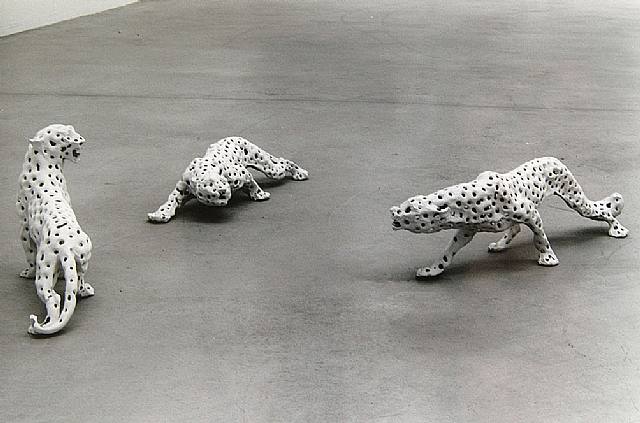
Richard Deacon's sandblasted ceramic tigers, which developed holes and were put it cages (here are some holey tigers by a different sculptor);
Clare Twomey's floor of fragile tiles, which had to be walked across;
African villages where the broken pots are used as floors of huts;
acrow props, the many uses of;
light sources for getting shadows in exhibition spaces;
combining see-through paper with densely opaque pottery, and other contrasts;
an exhibition at the Geffrye Museum, but unfortunately they don't have previous exhibitions on the website;
the Ronan Point towerblock collapse;
underpinning;
dipping metal mesh in clay;
Richard Wentworth's ladders;
the idea of defining space sparingly;
a Spanish ceramic artist whose name starts with G....