 ... somewhere over Greenland, probably. Got home to find fresh flowers and useful groceries (thanks, Thomas!). Had a cup of tea, unpacked, opened 5 weeks' mail, and dusted. Back to another reality...
07 March 2008
Woke up this morning...
... somewhere over Greenland, probably. Got home to find fresh flowers and useful groceries (thanks, Thomas!). Had a cup of tea, unpacked, opened 5 weeks' mail, and dusted. Back to another reality...


05 March 2008
Pretty hospital gowns - instructions
 Fabric -- Cut crossways, each gown takes 1.70 metres of 115cm fabric with an all-over pattern. Use a lightweight cotton, and prewash. For a one-way pattern, fold the fabric lengthways; you'll need about 2.5 metres.
Pattern -- The front pattern piece, without seam allowance, measures 90cm long at centre, 7cm across at the neck to sleeve seam and 31cm at the underarm, which is 24cm down from the neck. There's a slight (1.5cm) shaping below the underarm and the neck rises 2.5cm to the shoulder. The sleeve seam, which is at a 45 degree angle, is 36cm long. The bottom measures 39cm. The back has an extra 4cm in width all the way up, so it's 11cm at the neck and 43cm at bottom.
The sleeve is 41cm across the bottom and flares slightly to measure 47cm between underarm seams. It is 37cm high and measures cm from seam to seam at the neck, where it measures 6cm across. The seam has a steeper angle than on the body pieces.
Exact measurements aren't crucial as the gown has no "fit" as such - it just has to be roomy enough to get on and off easily.
Layout --
 In addition to the front (place on fold), back, and sleeve, you need a bias strip for facing the neck; cut this 4cm wide. You can usually cut it beside the sleeve seam of the front or back, by positioning the sleeve carefully. This strip will extend to make the neck ties, so cut it at least 50cm long, piecing if necessary. Waist ties are probably not necessary for someone who's bedridden, but can be cut 20cm or longer and later added 30cm down from the neck.
Construction -- I use french seams and add 1.5cm seams for these. You can of course serge/overlock the seams - and make it in half the time!
Sew all sleeve seams - for french seams, a narrow seam with wrong sides together, then press to one side, turn right sides together and sew wider seam.
Sew side seams - clipping the narrow seam at underarm is helpful when making french seams.
Turn a narrow hem on sleeves, back, and bottom.
Pin the bias strip to the neck, stretching it slightly, and sew .
 Turn and pin so there's extra fabric on the inside. Sew from the right side, "in the ditch";
 continue along the ties - fold the fabric to the centre, so there are 4 layers, and stretch the ties as you sew.
Now for the finishing touch - closely zigzag over the line of stitching in a matching colour. If you've used a different colour of bobbin thread and it shows slightly, you can edge the satin stitch with straight stitching.
 Of course you can add other kinds of embroidery too.
01 March 2008

Bags of fun
 Good thing this month has an extra day this year - it meant I could finally make the February bag for the BQL bag challenge. Of course I had to adapt it slightly - it was "supposed" to be decorated with hearts/leaves and scrolly bobbinwork stitching. This jungly fabric was hardly suitable for that sort of stuff - maybe that's why I chose it? Now it needs (at the request of the recipient) a pocket in the lining - that will be added by hand.
Next time: add zippered pocket to the lining, first thing. Use firmer wadding for the body. Make the handles a bit longer, and the bag body a bit shorter.
26 February 2008
Thought into action
Amid the changing BC weather, we have some good sunrises here. I've been photographing them, the sky orange beyond the blue mountains and the mist rolling through the black shapes of cedars, over the fields of red-stemmed blueberry bushes.
This morning brought a slash of orange among the rapidly shifting grey clouds. I caught myself thinking "if I had my paints here, I'd have a go at that" - and realised that I did have one tube of paint and could have a go.
 ok, it sure ain't art - but it's more valuable than the photographs, because some prolonged looking and thinking, and interaction, is involved.
This morning brought a slash of orange among the rapidly shifting grey clouds. I caught myself thinking "if I had my paints here, I'd have a go at that" - and realised that I did have one tube of paint and could have a go.
 ok, it sure ain't art - but it's more valuable than the photographs, because some prolonged looking and thinking, and interaction, is involved.
Crafty reading
Before bookstores had cafes, and certainly before "search inside" a book online, there were libraries. For no money, you could read all the books you wanted, in the comfort of your home, and didn't have to find space for storing all those books.
The bright blue bookmobile, similar to this one, that appeared every two weeks was a central point of my childhood. Herman Sherman and the library lady let me take home as many books as I could carry, and over the two weeks I'd usually get through them all. (Ah, the vast acres of empty hours of interminable childhood!)
Now that tiny little Pitt Meadows has become a built up suburb, among the shopping centres is the library, a treasure chest including new-to-me Canadian authors, and magazines that can be borrowed. Time for thoughtfully choosing books was limited on that first visit, but I couldn't resist taking "A knitting mystery" home -- unfortunately, a little went a long way, for example on p3: "Kelly turned to see Burt Palmer, retired cop and now spinner par excellence, grinning as he carried a huge bag of multicolored fleeces into the adjacent room."
Much more promising in terms of literary quality and discerning use of "technical details", and one I'll order on the internet, is The Girl who Stopped Swimming, which has an art quilter as the central character.
Meanwhile, I have a jolly book bag as a souvenir of all my years of using the Fraser Valley Regional Library. And the library has a "bestseller express" corner - 7 day loan, $1 a day overdue fine - where I found this and liked the cover:
 The central character is a book conservator, and the scene jumps to various historical periods, tracing the history of the manuscript and of the people involved with it. All very thoroughly researched, to the point of overload methinks. I was amused to read of the heroine taking a cab from Hampstead to Westminster because there wouldn't be time to do the journey by underground - even though the congestion charge now makes traffic less gridlocked, going by tube would probably be a better option; on the other hand, Hampstead is on the notorious Northern Line....l
The bright blue bookmobile, similar to this one,
 that appeared every two weeks was a central point of my childhood. Herman Sherman and the library lady let me take home as many books as I could carry, and over the two weeks I'd usually get through them all. (Ah, the vast acres of empty hours of interminable childhood!)
Now that tiny little Pitt Meadows has become a built up suburb, among the shopping centres is the library, a treasure chest including new-to-me Canadian authors, and magazines that can be borrowed. Time for thoughtfully choosing books was limited on that first visit, but I couldn't resist taking "A knitting mystery" home -- unfortunately, a little went a long way, for example on p3:
 "Kelly turned to see Burt Palmer, retired cop and now spinner par excellence, grinning as he carried a huge bag of multicolored fleeces into the adjacent room."
Much more promising in terms of literary quality and discerning use of "technical details", and one I'll order on the internet, is The Girl who Stopped Swimming, which has an art quilter as the central character.
Meanwhile, I have a jolly book bag as a souvenir of all my years of using the Fraser Valley Regional Library.
 And the library has a "bestseller express" corner - 7 day loan, $1 a day overdue fine - where I found this and liked the cover:
 The central character is a book conservator, and the scene jumps to various historical periods, tracing the history of the manuscript and of the people involved with it. All very thoroughly researched, to the point of overload methinks. I was amused to read of the heroine taking a cab from Hampstead to Westminster because there wouldn't be time to do the journey by underground - even though the congestion charge now makes traffic less gridlocked, going by tube would probably be a better option; on the other hand, Hampstead is on the notorious Northern Line....l
16 February 2008
Family dinner
Cooking up a storm - The table set for 12 -
 The menu was lentil and cumin chili/curry; Bombay potatoes; cashew chicken; various raitas and chutney; rice. The wine flowed freely. Ice cream (with chocolate sauce) followed eventually.
 The table set for 12 -
 The menu was lentil and cumin chili/curry; Bombay potatoes; cashew chicken; various raitas and chutney; rice. The wine flowed freely. Ice cream (with chocolate sauce) followed eventually.
15 February 2008


One ball short of a ...
Is there enough yarn to finish the cardigan for my dad? The body is done, sewn together, fitted; one sleeve is 3/4 done, the other half done - and there's not a lot of the green wool left (lots of grey left - and I've even found some buttons).
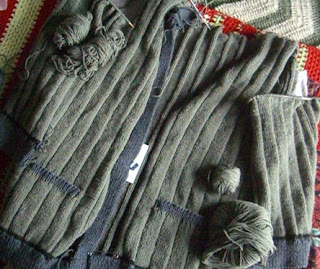 The choices are (a) take it back to the UK, get more wool there and knit the tops of the sleeves there, then mail it to him; (b) rip back the body to just below the armholes and make it a couple of inches shorter, freeing up enough wool to finish the sleeves (maybe); and (c) phone all over town for one ball of wool - fortunately I used an internationally-available brand, and there's a listing of all the yarn shops in BC, indeed in Canada, here.
 The choices are (a) take it back to the UK, get more wool there and knit the tops of the sleeves there, then mail it to him; (b) rip back the body to just below the armholes and make it a couple of inches shorter, freeing up enough wool to finish the sleeves (maybe); and (c) phone all over town for one ball of wool - fortunately I used an internationally-available brand, and there's a listing of all the yarn shops in BC, indeed in Canada, here.
13 February 2008
"Painted" wool
 This wonderful, extremely fine wool looks quite different off the skein, wound into a ball -- and different again when knitted. Because of all the colour changes in the wool you don't need a fancy pattern - but you do need a bit more than "just plain". This has evolved into a "pointy" scarf (3 in the 72 stitches) - the first 15" has used about half the wound-up wool, which means that in 2010 or 2012 when the scarf is eventually finished it will be about 60" (1m60) long. Unless the moths get to it first, that is.
10 February 2008
Practical sewing
First it was aprons for everyone on my Christmas list -
 Now I'm sewing a wardrobe of hospital gowns for a special person.
 There are many "community quilt" projects (eg Linus quilts for children in hospital), but I've not heard of a project for making pretty gowns for patients in longterm care. Yet they would be a morale booster for bedridden patients. The gowns are quick to make, take only 2 metres of fabric, and have scope for simple and effective embellishment.
 Now I'm sewing a wardrobe of hospital gowns for a special person.
 There are many "community quilt" projects (eg Linus quilts for children in hospital), but I've not heard of a project for making pretty gowns for patients in longterm care. Yet they would be a morale booster for bedridden patients. The gowns are quick to make, take only 2 metres of fabric, and have scope for simple and effective embellishment.
Scary thought?
"Obstacles are those frightful things you see when you take your mind off your goals." - Henry Ford
 Some people, though, see obstacles as opportunities.
 Some people, though, see obstacles as opportunities.
09 February 2008
What to do with sleeves
Traditional garments often have big sleeves - which surely got in the way when there was work to be done. This print by Utamaro shows how to tie kimono sleeves out of the way - The long sleeves on central Asian coats weren't a problem because the coats were worn over the head, "for best" (but just try to find a picture of this! Or even a decently large photo!) [but see the Update below]
 whereas the long sleeves of Palestinian costume were tied together behind the back when there was work to be done
 Throughout the ages, sleeves have been rolled up
 In China, sleeve protectors are worn - even by students

Update, Feb 2017
With the proliferation of pinterest, it's no longer difficult to find a photo of a traditional central Asian coat being worn the traditional way -

This site shows lots and lots of traditional central Asian garments.
Images of Palestinian traditional dress abound -
 The long sleeves on central Asian coats weren't a problem because the coats were worn over the head, "for best" (but just try to find a picture of this! Or even a decently large photo!) [but see the Update below]
 whereas the long sleeves of Palestinian costume were tied together behind the back when there was work to be done
 Throughout the ages, sleeves have been rolled up
 In China, sleeve protectors are worn - even by students
Update, Feb 2017
With the proliferation of pinterest, it's no longer difficult to find a photo of a traditional central Asian coat being worn the traditional way -

This site shows lots and lots of traditional central Asian garments.
Images of Palestinian traditional dress abound -
 |
| (via) |
07 February 2008
The values of craft
"It's certainly possible to get by in life without dedication, but the craftsman exemplifies the special human condition of being engaged." Richard Sennet's new book, The Craftsman, is getting a lot of media coverage, in the Guardian and the Telegraph, for a start. The quote comes from the Guardian's review, and is one of the "problems" with craftsmanship - the selfish pursuit of excellence, with disregard for market forces.
His notion of craft is more than the 19th century idea of working with your hands - it's the desire to do something well for its own sake, to become skilled, to develop competence. The book starts with the example of a Linux programmer, not a carpenter among wood shavings. It's a different way of understanding things - going over and over them - practising.
Another problem with craftsmanship is the class divide - being a "worker" has long been seen as demeaning. The competence that craftsmen aim for and exemplify is invisible to people at the top; workmanship isn't valued. Sennet says (paid) work should be structured so that workers build up competence -- good idea!
"Competence and engagement - the craftsman's ethos - appear to be the most solid source of adult self-respect, according to many studies conducted in Britain and the US." Let's get practising.
Richard Sennet's new book, The Craftsman, is getting a lot of media coverage, in the Guardian and the Telegraph, for a start. The quote comes from the Guardian's review, and is one of the "problems" with craftsmanship - the selfish pursuit of excellence, with disregard for market forces.His notion of craft is more than the 19th century idea of working with your hands - it's the desire to do something well for its own sake, to become skilled, to develop competence. The book starts with the example of a Linux programmer, not a carpenter among wood shavings. It's a different way of understanding things - going over and over them - practising.
Another problem with craftsmanship is the class divide - being a "worker" has long been seen as demeaning. The competence that craftsmen aim for and exemplify is invisible to people at the top; workmanship isn't valued. Sennet says (paid) work should be structured so that workers build up competence -- good idea!
"Competence and engagement - the craftsman's ethos - appear to be the most solid source of adult self-respect, according to many studies conducted in Britain and the US." Let's get practising.
Seasonal delights
Valentines cookies in seasonal heart shapes, with seasonally coloured sprinkles - and two-bite cupcakes (vanilla or chocolate) with seasonally pink icing -
 and of course the seasonal chocolates in their heart-shaped boxes (check out the one with the leather jacket, centre bottom) and the seasonally fluffy toys

 and two-bite cupcakes (vanilla or chocolate) with seasonally pink icing -
 and of course the seasonal chocolates in their heart-shaped boxes (check out the one with the leather jacket, centre bottom) and the seasonally fluffy toys
06 February 2008
Fabric shopping
It was great to be in a real fabric store, with bolts of cloth as far as the eye could see, a pattern counter, notions section, helpful staff... Among the flannelette and lightweight cottons I found these for hospital gowns (on consideration, not the lime green one on the right) --
 And this one for myself --

 Among the flannelette and lightweight cottons I found these for hospital gowns (on consideration, not the lime green one on the right) --
 And this one for myself --
Classic
 Temptation - 85 cents each at the Salvation Army thrift store on Lougheed Highway in Maple Ridge, BC. Is it true that the instructions were so much better, back then?
Ikat at the V&A
 The exhibition of Central Asian ikats is on until 30 March. It lifts the spirits. (I went to see it back in January, with some others from CQ.)
 On the left, a man's robe; the woman's robe on the right has more shaping. They're lined with printed cotton imported from Russia and England, among other places. The ikat fabric is silk (dyed) threads covering a cotton warp. The silk is tied and dyed up to seven times, and has to be spread out in groups of long threads and marked up before each dyeing. The white areas have to be carefully guarded!
This darker robe might have been worn by a woman in mourning. Ikat cloth was also made into wall hanging, lined again in cotton.
 Most garments in the exhibition are from 1875-1900, but there are also some more modern ones - with simpler designs and chemical dyes.
 My favourite - these simple circles. The white ones have red dye at the sides of the green circles in the centre.
 The woven panels are narrow and patterns don't necessarily "match". And what's that white, wavy line?


04 February 2008
Quote of the day
"Everything that irritates us about others can lead us to an understanding of ourselves." - Carl Jung
Interesting thought - and now, how to illustrate it? Googling "irritation" came up with, among the inflamed skin and patent medicines, this nostalgic image, touting the throat-soothing qualities of cigarettes - (How wrong they were!)
Interesting thought - and now, how to illustrate it? Googling "irritation" came up with, among the inflamed skin and patent medicines, this nostalgic image, touting the throat-soothing qualities of cigarettes -
(How wrong they were!)
Subscribe to:
Posts (Atom)