22 August 2006

The Shipping Forecast

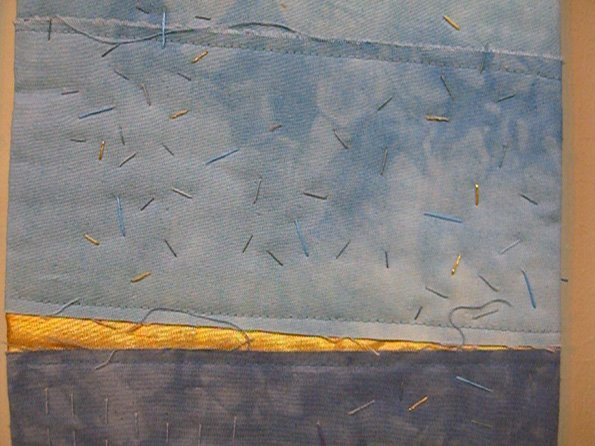
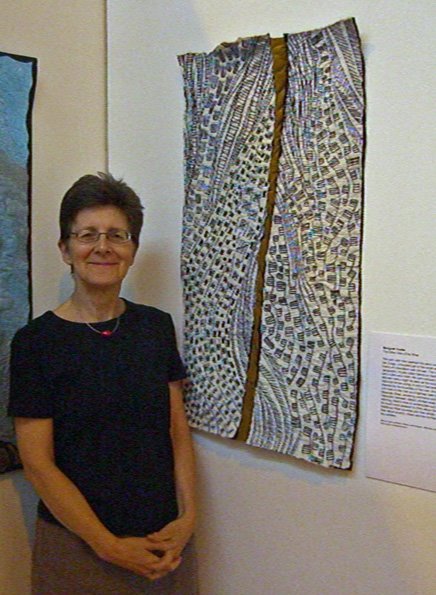
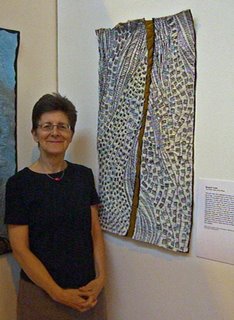
Among the many exciting shows within the show, my favourite was a series of atmospheric panels by Delia Salter, each representing an area of sea (don't they have wonderful names: Cromarty, Dogger, German Bight, South Uitsire [oot-seer-uh], Finisterre) covered in the daily weather forecast for maritime areas.

The FoQ site says: "Having grown up listening to the shipping forecast, the wonderfully poetic names became familiar and yet still held a certain strangeness – a wildness – something that signified foreign places and adventure. Delia has used fabric and thread to interpret the world around her and her relationship to it; the size and length of the long, thin strips used has helped emphasise the depth of the water, and the dark, unknown depths beneath the water."

Delia started with the white light of morning in Viking and moved through bright noon and afternoon to the grey evening of the final panels, ending (as does the forecast) with areas Fair Isle, Faeroes, and South East Iceland. The panels are based on specific forecasts, for example the first of the bright ones, Humber, is: 30 September. South [wind] backing east 4 or 5. Mainly fair [weather]. Mainly good [visibility]. They are unified by their size, and by the line of the horizon -- the swell of the ever-moving sea.
Stitching is minimal, but the effect is magical.

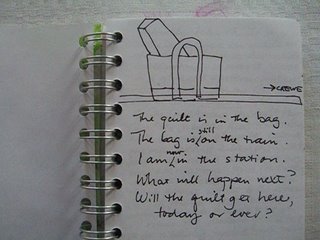
I left my quilt on the train!

Wednesday morning, with handbag, suitcase, and big blue bag containing packaged-up quilt for the Fissures exhibition, I'm catching the early train towards Birmingham and a two-day workshop with Jo Budd before a couple of days at the Festival of Quilts. The scenery rolls by, the train gets to Rugby, I collect my things and get off, change trains. Then comes the dreadful moment of realization:Shaken, I consider the worst that can happen, then formulate Plan A and Plan B, and try not to fret, stuck helpless on the connecting train. At Birmingham International station, Rob in the lost property office phones Crewe, the train's next stop; the train will get there in 5 minutes. The package will be taken from the overhead rack above seat C25 [I kept the ticket; thank goodness for reserved seats!] and put into the lost property office at Crewe. Rob gives me train times to Crewe so I can go collect it. It will take at least 3 hours to do so.

The quilt needs to be hung before the show opens at 10am next morning. Now the quandry is: to miss the morning of the workshop, or the afternoon; or will it be possible to go to Crewe after 4.30 and get the quilt to the exhibition before 10am next morning? I formulate a new Plan A and a Plan B...

I make my way to the Fissures stand and find no-one there, so start to write a note of explanation. Various people come and drop off their quilts, and I tell my tale of woe to anyone who will listen. Everyone is aghast, then sympathetic; I'm so glad my quilt isn't still on the train, heading for Glasgow, that I don't much care if they think that leaving it on a train is a right daft thing to do.

Having done what I can, I go to the workshop and again tell my tale of woe to everyone there; I can think of nothing else, after all. And a miracle happens -- someone who must remain nameless offers to drive to Crewe and collect it. (She was acting subversively and I don't want to get her into trouble.) Thank you, thank you, anonymous angel! She would accept no recompense, so I'll be "paying it forward".

The quilt got to the Fissures exhibition after all. Who's a happy bunny, then? As for the entire Fissures exhibition, it looked really, really good, and some of the visitors commented that it was the best exhibition in the entire show. Thanks to Bailey, Susan, and everyone else involved for their hard work getting the Fissures exhibition up, and to others in Contemporary Quilt who are planning more activites.
15 August 2006

Something blue

This is "Deep Blue Yonder" by Christine Restall. She brought it to show'n'tell at London Quilters and it was part of the Quilters' Guild "Connected" Challenge at the (first) Festival of Quilts in 2003.

The catalogue from that challenge surfaced this morning, coincidentally with a discussion on AQL of what makes a quilt an art quilt. The discussion is ranging thoughtfully through craft, design, intention, materials, techniques -- and of course the position of quilts in the craft and/or art world (just can't get away from that one!).In regard to starting points for quilts (a new twist on a pattern, followed by another twist, and another? seeing two fabrics together and thinking Hmm that's interesting? the burning need to voice some passionate belief?) -- does an ART quilt (or indeed any piece of art) have to start with an idea, with content, rather than from putting shapes, colours, fabrics together? Can communicating a thought or an emotion happen even though the starting point might have been, eg, happening to be sorting out all your blue fabrics after you saw one of Yves Klein's deeply blue paintings, and suddently wanting to make a piece that has the same luxurious enveloping effect? I don't know if this is how Christine's "Deep Blue Yonder" came about, but in her artist's statement she says: "I wanted to make an extremely blue quilt, connected with the unexplored mysteries of deep space and deep ocean; also with the ultramarine depths of Yves Klein's paintings". The quilt does convey that kind of mystery -- she has artfully arranged things so that it does.

11 August 2006

Mini-workshop

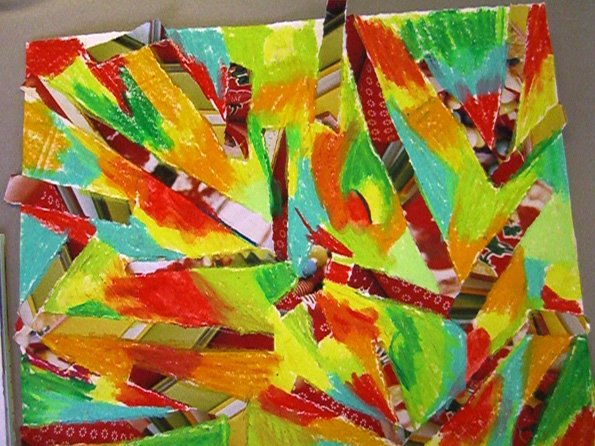
On Sunday morning there was a chance to do something different with another tutor. I chose to instantly become an abstract artist. Sue started us off tearing shapes out of colourful magazine pages and glueing them onto cartridge paper.Then we coloured in the empty spaces with oil pastels -- preferably Sennelier; we had a chance to compare various brands. No point in stinting on art materials - using them gives such pleasure. Time was short and we worked furiously, despite yet another day of heat.Then we cut up our colourful sheets of paper, and arranged them singly or in groups on sketchbook pages. I'd been discouraged at how gloomy my "purple" page turned out, but cutting it up utterly transformed it. And the other page had some good outcomes too.This is such a fun thing to do -- restores the spirit. Next time, hollow circles ...

Meanwhile, elsewhere ...

Sue Dove's workshop was a hive of activity. She'd brought her sketchbooks, art dolls, and other inspiring work.By Day 2, work had moved out of sketchbooks and onto the walls.

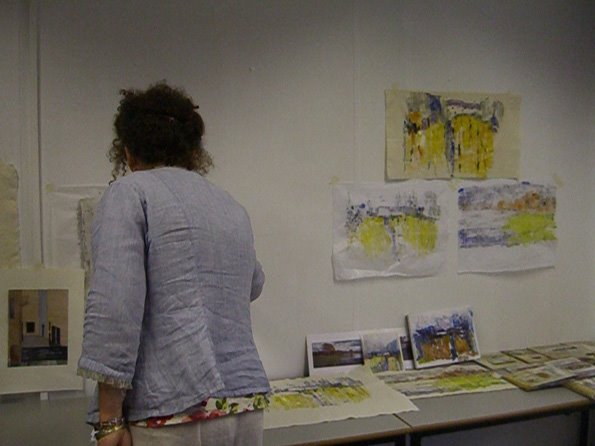
Sandra's class had started with everyone sloshing paint over all the pages of their sketchbooks, and working on those coloured pages.The results were fascinating, and each person developed a larger piece outside the sketchbook.
And outside, the scenery just ... was. Those are the Malvern Hills in the distance (possibly about 8 miles away).

Drama at the workshop

Bailey started with a fuschia, but didn't like the result: "I shouldn't have added the blue," she was heard to say."Well, cut it up!" we urged her. Watched encouragingly by Sian, she did (into a fibonacci sequence of course).Sian found some pink fabric --And Bailey added some wild wool --
A miraculous difference!

10 August 2006

Workshop

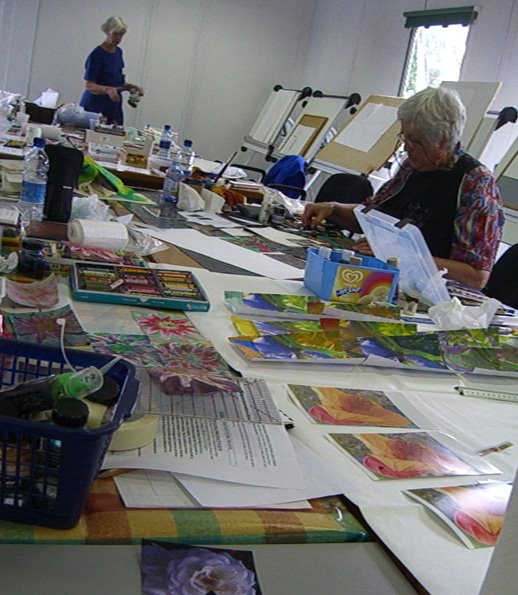
Sian Martin's two-day workshop was called "Design, Divide, and Decorate". First we did some dyeing, using procion dyes and plastic bags - no need to wet silk, and the colours came out intense if the dye was left to cure for a few hours.
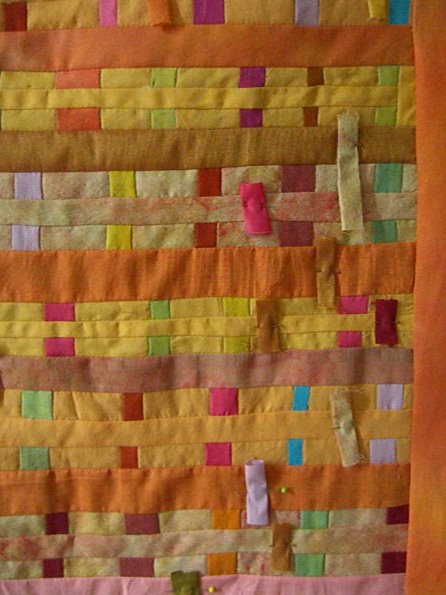
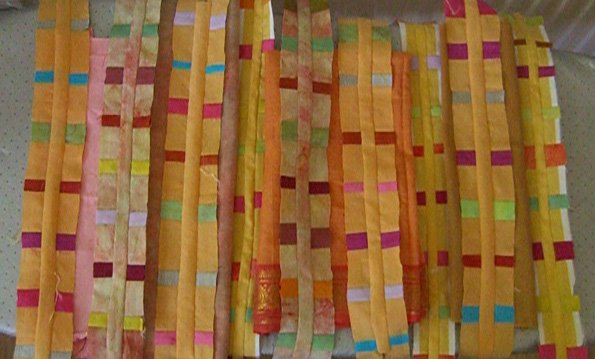
Sian had brought along some scraps -- now this is what I call scraps, less than 1/2" wide! Later we tore up some of our dyed fabric into similar strips.
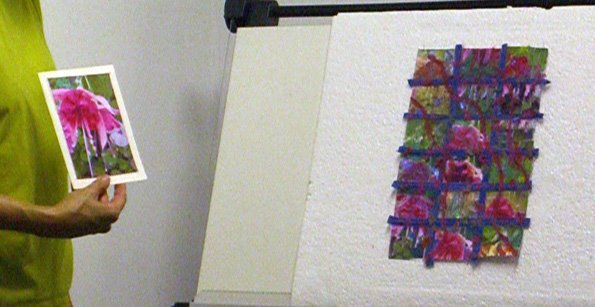
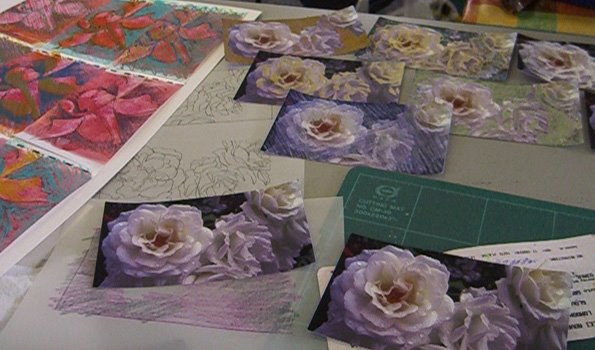
The "divide" part of the workshop was on using fibonacci series and the golden section. We practised with plain paper first. Then the decorating started -- on the 9 copies of a picture of a flower we each brought, not knowing how it was to be used.
After trimming our photos to golden section proportions, we went at them with inks, dyes, pastels, markers, crayons, paint, making them as various as possible. Sian's brightly coloured example didn't shake me out of pastel mode.
But once a bit of stitch got onto them, things started looking brighter --
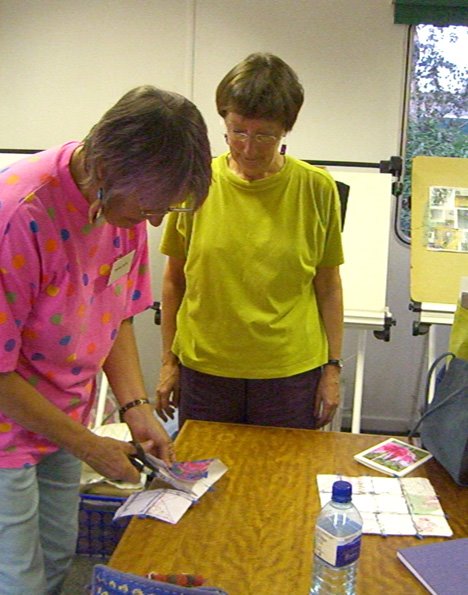
Here's a close-up of the ones with fabric couched on, snippets stitched on, and strips of fabric stitched into the paper. Bottom left is my "new boyfriend" - the one I couldn't bear to cut up - a simple, quick application of emulstion paint with the corner of a square piece of foam rubber, and some crayon cross-hatched on the background.Cut up and rearranged - but what to do next? Eventually a collage of fabrics just happened - it needs quilting onto the background, and then the roses will be attached with hand stitch.

Show-and-tell

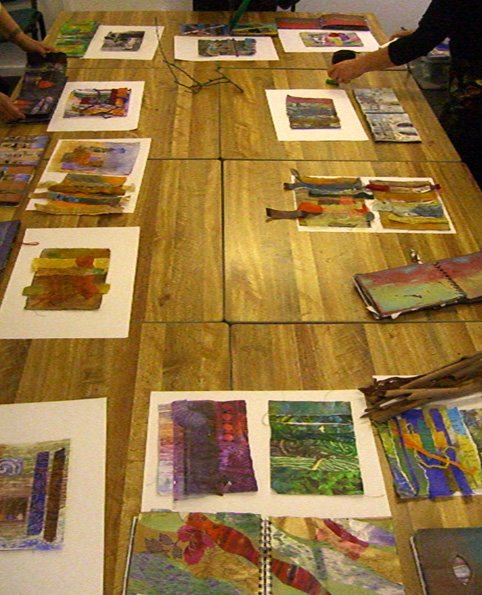
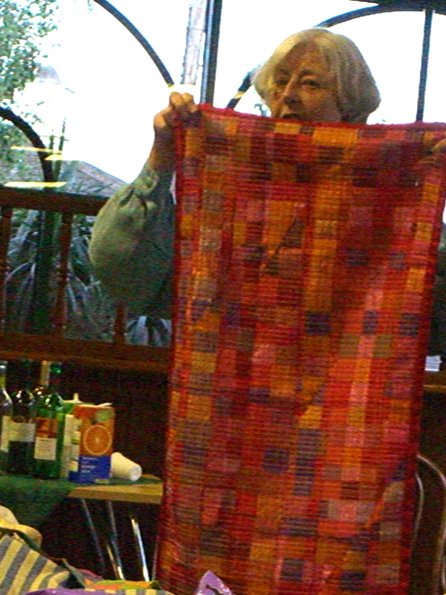
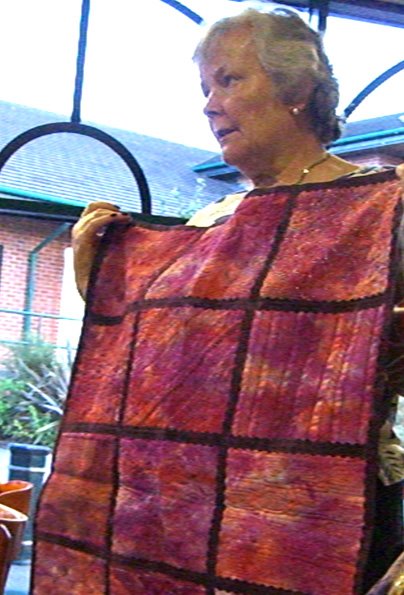
On the first evening, the show and tell included Sally-Ann's layers of interwoven strips--Susan's gorgeous and exciting rust dyeing --
Georgina's subtle variations --
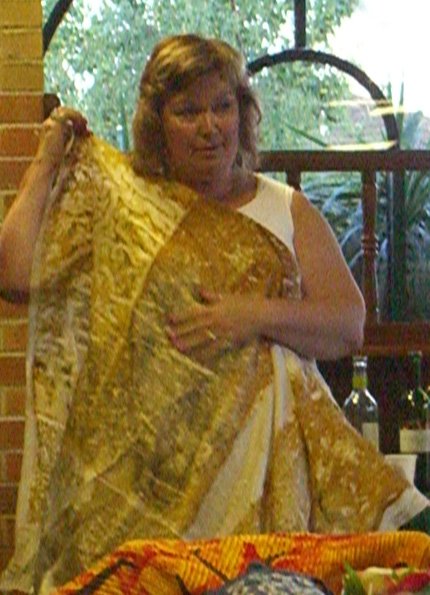
Ronnie's transformed print-table cloth --
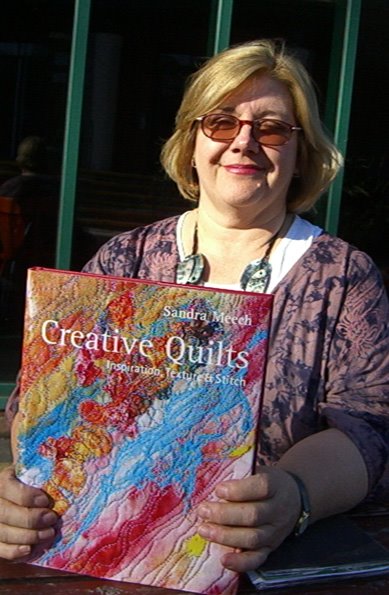
And Sandra's new book --

09 August 2006

Fleeing the city

I'm on the train - in a tunnel - on the way to deepest Gloucestershire for Contemporary Quilt's summer school. That was last week.
On the way, stone-built villages nestled among hills.With the occasional important building --
And allotments on the outskirts of the village. Lots of green, a welcome change from the city.

"Contemporary" out of "traditional"

One way to get started on a new quilt is to write about it. I found myself pontificating on contemporary quilts in an email to Martha Ann, saying "Maybe what scares people in making contemporary quilts is that the outcome isn't cut and dried -- you have to stop every now and then and look and see if it's working, and that's a bit risky. But rewarding." (Since then I've been tormented by conflicting thoughts and indecision on "what is a contemporary quilt, anyway" and "how is it different from an innovative quilt"? -- now that the colour of stair carpet is decided, I need something else to worry about and be indecisive over.)

Martha Ann had sent a pic of a Pennants quilt (much nicer than the one above!), so on that basis I went on: "I was going to adapt the Pennants quilt to be "contemporary" I'd do something "different" -- in about half of it. Introduce assymetry, and something discordant -- but try to keep balance and harmony -- a tall order! Maybe have borders on just two sides, or scale down half the blocks and then put "borders" on two sides of the block to get it the same size as the others. Or else play around with the colouring, or use, eg fabric printed with words, in some of the blocks, and put some words on the borders or else embroider some words among the quilting."

A title popped into mind and the idea of actually making this quilt took hold -- I would call it "Penance" - in repentance at wagging my cyberfinger at Martha Ann, trying to push her into the Land of Contemporary Quilts.

Also, a "contemporary" quilt might need "meaning" -- a bit of research was in order. Here's what Wikipedia says about penance: "Penitential acts [commonly] consist simply of prayers, fasting, and charitible work or giving, or a combination thereof. Such penance is frequently accompanied by a requirement for the penitent to be reconciled with anyone against whom he or she has sinned. The most common penances involve the recitation of standard prayers, such as the Lord's Prayer and the Hail Mary, meditation on particular scriptural passages, or praying the rosary with special penitential intentions."
Amid the quilting could be words from prayers, or phrases like "full of grace" or "hallowed be" might be useful for setting the "feeling" of the piece, to be expressed in use of colour. And it would be fun to use some non-traditional material -- paper with writing on it, shopping lists -- then the penance could be penance at over-consumption?Out came the notebook, to doodle down a few ideas - during that process I discarded the idea of altering just half the quilt and decided to Go The Whole Hog. Out came the paper and scissors to try out the blocks -- it's yet another way to doodle, a speedy way to make a few blocks so they can be recombined, and seen full size.The doodles, the development and - over the page - some serious measurement, and some limits -- 36" wide would be enough penance. After all, the original mental picture was of something the size of a journal quilt, maybe.
Below, trial blocks made up of four 4" blocks. In the one at the top, pages of food magazines (the first thing that came to hand) were glued to the fabric, the paper wetter, the excess rubbed off -- unsuccessfully; is there a better way? In the bottom block, machine stitching holds the bits of paper between the top layer and the luscious scarlet (polyester organza) backing. The extra stitching in the top block is done with thin strips of silk, to hold the corners down. Not sure where that aspect is going... referring back to my research, the piece has quilting and it has words to meditate on during that quilting (even if they are merely glimpsed in passing). The entire concept will develop as it adapts to the fabric I have on hand.

Drowning in colour

Back from the CQ summer school at Hartpury with a changed outlook on colour; changing my ways of working will have to wait till there's actually time to work, after the painting of rooms is done.

The piece started last week is coming along; it seems to need more and more dabs of colour. It started out as long strips an inch wide.

And on the home front, magazines have to go, to make room for books on the shelves. On the left, a few pages torn out, magazine ready to discard; on the right, still to go through. Unfortunately the heap of magazines that is still upstairs, waiting for liberation, is about 10 times this high.

01 August 2006

Work in progress

He says it will be completely finished tomorrow. I can hardly wait, but meanwhile am taking everything out of the kitchen cupboards and giving it all a good clean. No point in going into the sewing room -- can't get to the sewing machine for all the furniture in the way. However, there is an oasis of calm normality under the dust sheets: my desk.

Comments on comments

Felicity - I left the bus behind, hoping some child would happen upon it and be allowed to keep it OR (better?) encouraged to turn it in to Lost Property.

Linda - looking forward to seeing your ragged raw-edges quilt!

Anne - the two curved lines of raggedness in the aerial photo are rivers, cut into coulees below the level of the flat land. I've been to Alberta (lived in Calgary for a while) and it looks nothing like this from the ground. This photo (by Grant Neufeld; found via a quick Google) gives you an idea of the fields stretching away from the side of the road. The post is because the road can get snowed over in the winter!!

Postcards

Each of these will make two postcards - the blocks of colour are held on by horizontal lines of black stitching, and the background has thin, indeed almost invisible, stripes of white.

When the finished size is 4" x 6", scale is important. The piece below is larger than that - about 16" high - and unfinished. Can't decide whether it's going to be horizontal or vertical - once the intermediate stripes are in, it will tell me.