 It has a chapter on shadows
 including "shadow of the photographer" (of which I have my own huge collection)
 It has a chapter on shadowsincluding "shadow of the photographer" (of which I have my own huge collection)
 It's strips of thin plain silk, little bits of heavier flowery vintage silk, strips of dupion stamped with characters like "love" and "peace" (and flower, beauty, grace, happiness, from a set of rubber stamps, put together to resemble lines of chinese poems). The parallel stitching functions as quilting, and with a bit more practice I'll be able to get nice smooth curves -
  "Rainstorms" was in the "Elemental" challenge--
 It incorporates monoprints done on fabric with ordinary printing ink (I like the type of mark you get this way) -
 and it also uses layers of overlapping sheer fabric -
 Unable to get out to see an exhibition one grey Sunday morning, I started thinking about one seen in 2006 -- the huge paintings of John Virtue, a landscape artist who lives in Devon and was artist in residence at the National Gallery.
 Instead of the usual three layers, I'm using a combined backing/wadding of fleece. It happened to be around; I don't have a big enough piece of wadding on hand, and want to get this finished! The machine quilting is a bit scary, though - a little practice on a scrap is definitely needed.
 8 inches square - trying out different threads with one kind of stitched mark. The two layers and little coloured border makes it feel good to do.
 What a scene of concentration. Note the fabrics on the bench - these are Lisa's hand-dyes, and the ones spread open are painted, graded from one colour to another. Irresistible.
 Lisa uses her painted fabric for whole-cloth creations. She paints several layers at once - including a top layer of organza. This piece is embellished with lots of beads -
 By mid-afternoon we each had a few blocks ready. Here's Lisa giving us some tricks for getting the layout to work -
 Back home I kept right on working, embellishing all my hand-dyed recylced damasks - there are enough to make a piece 48" square. This lurid photo shows my blocks laid out, ready to sew together - and quilt, of course. The blue border (still to come) will have a block jutting into it -- which, Lisa explained, saves buying huge amounts of fabric, just to cut the long borders along the length.
 Of course in a workshop you have to get out of your comfort zone at least once. I really resisted the eyelash yarn at first, but by the end of the day had to ask for some more....


 And some of his other work -


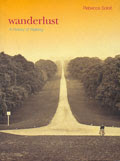
Interestingly, the book has a little pathway at the bottom of each page, along which run quote after quote - about walking, of course.
"In my room the world is beyond my understanding," wrote Wallace Stevens in "On the Surface of Things", "But when I walk I see that it consists of three or four / Hills, and a cloud."
 Gosh it was almost a year ago that the CQ committee met in Birmingham. On the way to the Cornelia Parker exhibition at the Ikon Gallery, we were busy with our cameras -
 Here's the gallery, a converted school in a renovated area near the canal -
 Nice original features -
 I found the reflections of the work, in the glass protecting some of the work, as interesting as the work itself - these suspended bits of earth are from the works around the leaning tower of Pisa; the people in the gallery add something that's otherwise missing -
 Exhibitions give you fresh eyes to take back to your own environment. Like for this bit of plaster dripped by a careless workman, renovating a bathroom -
 My own eye was captured by drapery in a painting by Donato Ceti, 1713, and by this combination of colours:
 The photo is in "5000 years of textiles", ed. Jennifer Harris, published in 1993 by British Museum Press, paperback edition 2004.
 Beyond the Buckinghamshire-Oxfordshire border the road drops down from the hills, usually a great view. This time we were cheered by the brighter sky.
 I love this hillside, even in the rain -
 After sorting stuff out in the boatyard, we headed towards Banbury. Here's the famous Banbury Cross -
 And some advertising from pre-internet days -
 The town has a great cookshop, lots of temptation --

 More murk and torrents of rain on the way home. Photographing the spray kept me busy.
 Watch out pedestrians!
 And then there was this. Most cars were turning back, but we saw a cyclist going through, and the water only came just over his chain -
 that water did make the car smell rather. The cyclist looked pretty disgusted, too.
 Here it is all gathered up -
 And painted with fabric paint (with a bit of purple on the other side) -
 Released -
 Ready - but for what? - with the threads plaited, ready to be used for another one -
 In my impatience to undo it, I ironed it dry, and made these prints in the process -


