23 August 2006

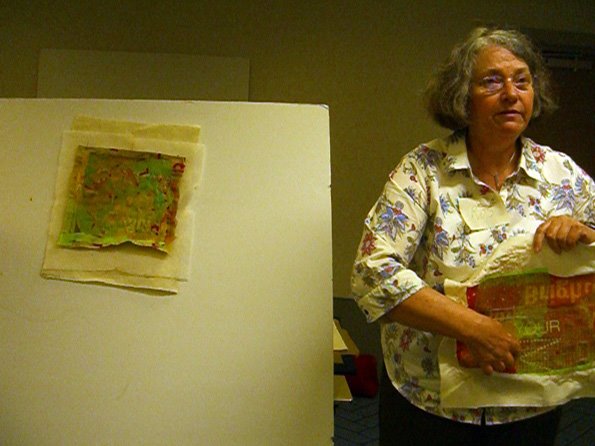
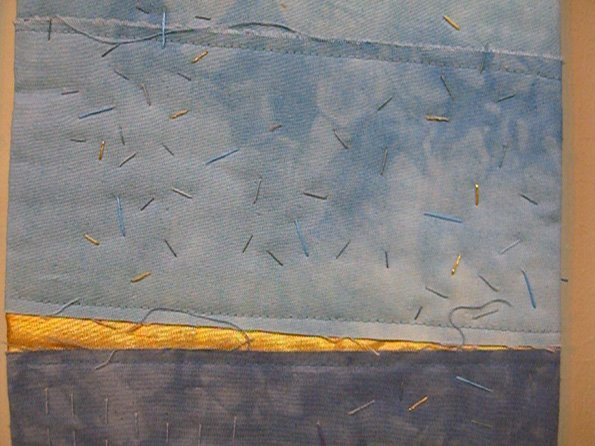
Amazing what a little heat will do to layers of plastic bags - not just weld, but distort in interesting ways. I particularly liked using thick pink builders' plastic, together with graphic elements from carrier bags, over a grid of rug-hooking canvas, which textures the layers. And thin strips made by cutting out the bag seams, which are already bonded, made for good linear elements.Smaller sections can be juxtaposedJo showed us various uses of fabric and machine stitch (invisible thread in the top) along with the plastic. I was entranced by plastic itself, but did come up with this "dress", with the thin silk (dyed at Hartpury!) coming up through holes in the plastic of the "hem" and held by a rather disturbing layer of pins.
Here's a close-up of the interesting textures you can get. The plastic doesn't stick to the rug-canvas grid -- but it will stick to the iron if you have any that's not covered by baking parchment. Only a moment of ironing is needed -- and the plastic will go on shrinking and wrinkling unless you slap something flat and heavyish over it quickly.
When I got home I made a cover for the compost heap, using what was on hand -- Waitrose bags. This is about a metre square.
At the end of the workshop we looked at what everyone had done. Carole-Ros-
Christine -
Jane -
Brenda-
Jeanette-
Pauline-
Janet (who never uses pink!) -
Gaynor-

Behind the scenes

Wednesday morning - the day before the show opens. 24 hours earlier, this would have been empty space (well maybe the carpet would be laid down). 24 hours later, the traders' booths will all be set up, ready for the hungry hordes. What a lot of work goes into the show!Here are the judges' toolkitsand here are the judges, briefed and ready to
get on with a long day of judging -- apart from selecting winners in each category, they supply three sets of comments for every quilt (and there were more than a thousand this year).

22 August 2006

The Shipping Forecast

Among the many exciting shows within the show, my favourite was a series of atmospheric panels by Delia Salter, each representing an area of sea (don't they have wonderful names: Cromarty, Dogger, German Bight, South Uitsire [oot-seer-uh], Finisterre) covered in the daily weather forecast for maritime areas.

The FoQ site says: "Having grown up listening to the shipping forecast, the wonderfully poetic names became familiar and yet still held a certain strangeness – a wildness – something that signified foreign places and adventure. Delia has used fabric and thread to interpret the world around her and her relationship to it; the size and length of the long, thin strips used has helped emphasise the depth of the water, and the dark, unknown depths beneath the water."

Delia started with the white light of morning in Viking and moved through bright noon and afternoon to the grey evening of the final panels, ending (as does the forecast) with areas Fair Isle, Faeroes, and South East Iceland. The panels are based on specific forecasts, for example the first of the bright ones, Humber, is: 30 September. South [wind] backing east 4 or 5. Mainly fair [weather]. Mainly good [visibility]. They are unified by their size, and by the line of the horizon -- the swell of the ever-moving sea.
Stitching is minimal, but the effect is magical.

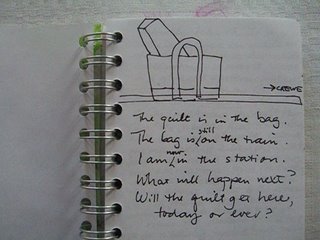
I left my quilt on the train!

Wednesday morning, with handbag, suitcase, and big blue bag containing packaged-up quilt for the Fissures exhibition, I'm catching the early train towards Birmingham and a two-day workshop with Jo Budd before a couple of days at the Festival of Quilts. The scenery rolls by, the train gets to Rugby, I collect my things and get off, change trains. Then comes the dreadful moment of realization:Shaken, I consider the worst that can happen, then formulate Plan A and Plan B, and try not to fret, stuck helpless on the connecting train. At Birmingham International station, Rob in the lost property office phones Crewe, the train's next stop; the train will get there in 5 minutes. The package will be taken from the overhead rack above seat C25 [I kept the ticket; thank goodness for reserved seats!] and put into the lost property office at Crewe. Rob gives me train times to Crewe so I can go collect it. It will take at least 3 hours to do so.

The quilt needs to be hung before the show opens at 10am next morning. Now the quandry is: to miss the morning of the workshop, or the afternoon; or will it be possible to go to Crewe after 4.30 and get the quilt to the exhibition before 10am next morning? I formulate a new Plan A and a Plan B...

I make my way to the Fissures stand and find no-one there, so start to write a note of explanation. Various people come and drop off their quilts, and I tell my tale of woe to anyone who will listen. Everyone is aghast, then sympathetic; I'm so glad my quilt isn't still on the train, heading for Glasgow, that I don't much care if they think that leaving it on a train is a right daft thing to do.

Having done what I can, I go to the workshop and again tell my tale of woe to everyone there; I can think of nothing else, after all. And a miracle happens -- someone who must remain nameless offers to drive to Crewe and collect it. (She was acting subversively and I don't want to get her into trouble.) Thank you, thank you, anonymous angel! She would accept no recompense, so I'll be "paying it forward".

The quilt got to the Fissures exhibition after all. Who's a happy bunny, then? As for the entire Fissures exhibition, it looked really, really good, and some of the visitors commented that it was the best exhibition in the entire show. Thanks to Bailey, Susan, and everyone else involved for their hard work getting the Fissures exhibition up, and to others in Contemporary Quilt who are planning more activites.
15 August 2006

Something blue

This is "Deep Blue Yonder" by Christine Restall. She brought it to show'n'tell at London Quilters and it was part of the Quilters' Guild "Connected" Challenge at the (first) Festival of Quilts in 2003.

The catalogue from that challenge surfaced this morning, coincidentally with a discussion on AQL of what makes a quilt an art quilt. The discussion is ranging thoughtfully through craft, design, intention, materials, techniques -- and of course the position of quilts in the craft and/or art world (just can't get away from that one!).In regard to starting points for quilts (a new twist on a pattern, followed by another twist, and another? seeing two fabrics together and thinking Hmm that's interesting? the burning need to voice some passionate belief?) -- does an ART quilt (or indeed any piece of art) have to start with an idea, with content, rather than from putting shapes, colours, fabrics together? Can communicating a thought or an emotion happen even though the starting point might have been, eg, happening to be sorting out all your blue fabrics after you saw one of Yves Klein's deeply blue paintings, and suddently wanting to make a piece that has the same luxurious enveloping effect? I don't know if this is how Christine's "Deep Blue Yonder" came about, but in her artist's statement she says: "I wanted to make an extremely blue quilt, connected with the unexplored mysteries of deep space and deep ocean; also with the ultramarine depths of Yves Klein's paintings". The quilt does convey that kind of mystery -- she has artfully arranged things so that it does.

11 August 2006

Mini-workshop

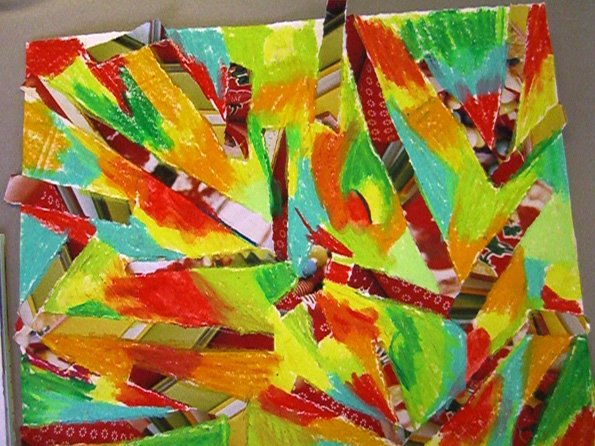
On Sunday morning there was a chance to do something different with another tutor. I chose to instantly become an abstract artist. Sue started us off tearing shapes out of colourful magazine pages and glueing them onto cartridge paper.Then we coloured in the empty spaces with oil pastels -- preferably Sennelier; we had a chance to compare various brands. No point in stinting on art materials - using them gives such pleasure. Time was short and we worked furiously, despite yet another day of heat.Then we cut up our colourful sheets of paper, and arranged them singly or in groups on sketchbook pages. I'd been discouraged at how gloomy my "purple" page turned out, but cutting it up utterly transformed it. And the other page had some good outcomes too.This is such a fun thing to do -- restores the spirit. Next time, hollow circles ...

Meanwhile, elsewhere ...

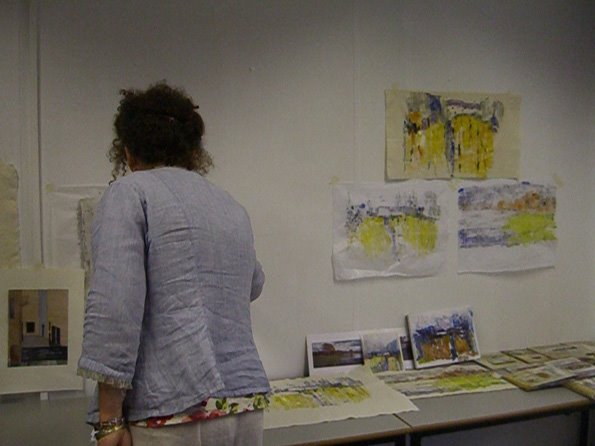
Sue Dove's workshop was a hive of activity. She'd brought her sketchbooks, art dolls, and other inspiring work.By Day 2, work had moved out of sketchbooks and onto the walls.

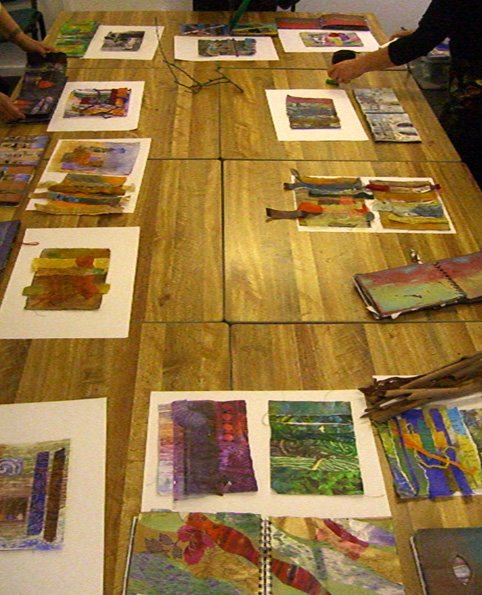
Sandra's class had started with everyone sloshing paint over all the pages of their sketchbooks, and working on those coloured pages.The results were fascinating, and each person developed a larger piece outside the sketchbook.
And outside, the scenery just ... was. Those are the Malvern Hills in the distance (possibly about 8 miles away).

Drama at the workshop

Bailey started with a fuschia, but didn't like the result: "I shouldn't have added the blue," she was heard to say."Well, cut it up!" we urged her. Watched encouragingly by Sian, she did (into a fibonacci sequence of course).Sian found some pink fabric --And Bailey added some wild wool --
A miraculous difference!

10 August 2006

Workshop

Sian Martin's two-day workshop was called "Design, Divide, and Decorate". First we did some dyeing, using procion dyes and plastic bags - no need to wet silk, and the colours came out intense if the dye was left to cure for a few hours.
Sian had brought along some scraps -- now this is what I call scraps, less than 1/2" wide! Later we tore up some of our dyed fabric into similar strips.
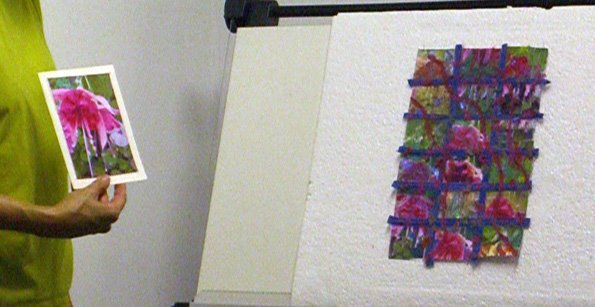
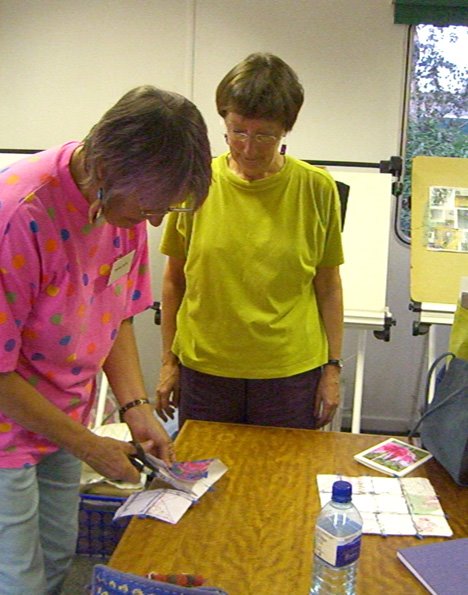
The "divide" part of the workshop was on using fibonacci series and the golden section. We practised with plain paper first. Then the decorating started -- on the 9 copies of a picture of a flower we each brought, not knowing how it was to be used.
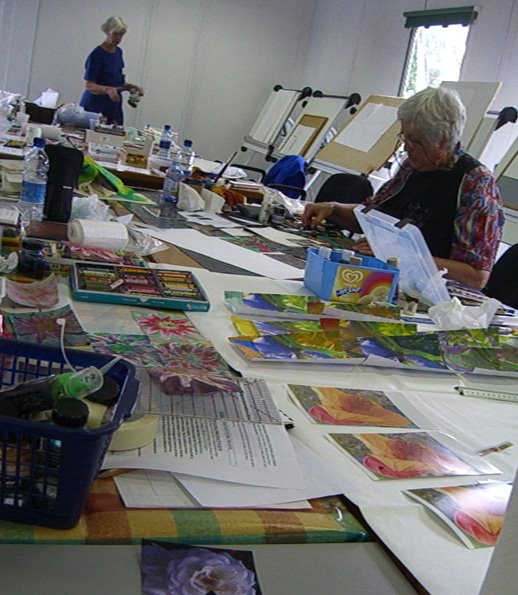
After trimming our photos to golden section proportions, we went at them with inks, dyes, pastels, markers, crayons, paint, making them as various as possible. Sian's brightly coloured example didn't shake me out of pastel mode.
But once a bit of stitch got onto them, things started looking brighter --
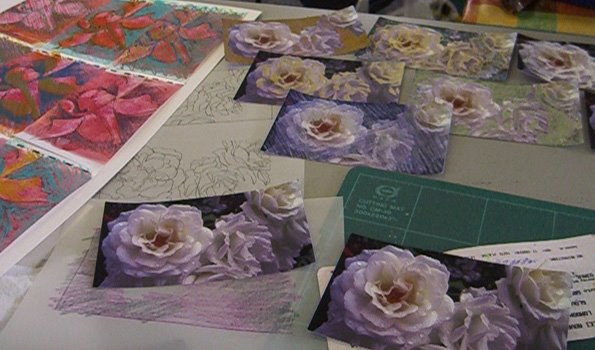
Here's a close-up of the ones with fabric couched on, snippets stitched on, and strips of fabric stitched into the paper. Bottom left is my "new boyfriend" - the one I couldn't bear to cut up - a simple, quick application of emulstion paint with the corner of a square piece of foam rubber, and some crayon cross-hatched on the background.Cut up and rearranged - but what to do next? Eventually a collage of fabrics just happened - it needs quilting onto the background, and then the roses will be attached with hand stitch.