19 May 2018

Rachel Howard at Newport Street Gallery

The series, "Repetition is Truth - Via Dolorosa" includes 14 paintings, in parallel with the Stations of the Cross, and standing in front of each does make you pause. The colours are subtle, the content is abstracted, the finish is extraordinary. And the connection to violence, horror, atrocity isn't immediately obvious.

But the subject matter is based on a famous photograph, The Hooded Man - showing the torture of an Iraqui detainee at Abu Ghraib prison in 2004. 
Study, 2005

A small painting that started a large series
Walking between the paintings in the large rooms in the gallery is rather like visiting a cathedral...

Howard's method of creating these works involves a process stretched out over time. She uses household gloss paint, and allows it to sit in the can so that pigment and varnish separate. Standing on ladders and scaffolding, she pours "vast swathes" of the pigment down from the top of the canvas "before using the varnish to add weight and momentum to the medium, pushing the paint down the surface to produce a veil-like effect". Each layer is left to dry for a month. Sometimes she applies a layer of acrylic paint before the gloss, "giving rise to occasional glimpses of fluorescence".
Shiny, glossy, smooth, subtle
The layers of paint and the veil of varnish create a subliminal surface, catching the internal and external lighting in subtle ways -
Reflective
More glimpses of under-layers at the edge

Howard became fixated by the box the hooded man was standing on - an interplay with the cross in the crucifixion - which emerges and dissolves in some of the paintings -
The fascinating box - with "glimpses of fluorescence"

 The information leaflet offers a fuller explanation -

Showing till 28 May.

18 May 2018

The "new" Royal Academy

After much hoo-haa the enlarged Royal Academy has officially opened, expanding into what was once the Museum of Mankind, where I spent many a happy hour and where, thanks to an all-day free event about Palestinian costume, I rediscovered "the itch to stitch" ... and that made all the difference ...

What was different at the RA, apart from the fresh paint and extra space (high ceilings!) was the incorporation of bits of "history", such as these fragments mounted high on the walls of the bridging section between the buildings -
 We went to see Tacita Dean's "Landscape" show - gorgeous drawings on slate -
cloudscapes roiling at low level...

... and hanging high up in the sky...
I was delighted by her collection of four, five, six, seven and nine leaf clovers -
1972 to present

A large gallery contains important historical works - some enormous paintings and smaller things like these amazing engravings -

And tracings (!) of costumes, research for medieval paintings by Millais -

A lovely little courtyard, a rest for the eye -
but perhaps the opening day came just a bit too soon? -

17 May 2018

Poetry Thursday - Everything is Going to be All Right by Derek Mahon

"The sun rises in spite of everything"

Everything is Going to be All Right - Derek Mahon

How should I not be glad to contemplate
the clouds clearing beyond the dormer window
and a high tide reflected on the ceiling?
There will be dying, there will be dying,
but there is no need to go into that.
The poems flow from the hand unbidden
and the hidden source is the watchful heart.
The sun rises in spite of everything
and the far cities are beautiful and bright.
I lie here in a riot of sunlight
watching the day break and the clouds flying.
Everything is going to be all right.


Derek Mahon (b1941) was born in Ireland and made literary friendships at Trinity College Dublin. After a time at the Sorbonne and working his way through Canada and the US he taught school in Dublin and worked as a freelance journalist in London. He now lives in Co.Cork, Ireland. Since 1965 he has amassed a raft of publications and won several poetry prizes. A biography by Stephen Enniss details the life context of Mahon's poems.

Encountered in the "Reconciliation" episode of BBC Radio 3's excellent "Words and Music" programme (12 days left to listen at time of writing).


16 May 2018

Woodblock Wednesday - reconsiderations

Opening April Vollmer's Japanese Woodblock Print Workshop at random as I sat down to breakfast, I found myself reading about papermaking for mokuhanga and how washi differs from Western papers. Then, thinking to invest in a decent brush (mizubake) for wetting and/or sizing paper, I found myself reading about papers again (at rospobio.blogspot.co.uk) and, seeing the range in results obtained, determined to try a few of the papers on hand here, just to see what happens.

In the "proper" process, there are so many nuances for each aspect ... quite beyond me at this point and maybe forever ... but I'm not averse to using the process "improperly". At the moment, it's a matter of making lots of prints so that Just Doing It becomes easier and the results better, and some sort of control of the desired results develops.

So, into the studio, get a block soaking and choose a colour or two, and search out some papers.

but

Things don't always go as planned (do they?) - looking back through what I'd already printed, and thinking about the "two page book" project, I got caught up in "using what's there" rather than extending the field of operations.

These two had been stitched together, trying out various covers -


The alignment of the blocks isn't right - it should work as a totality, as in some of the traditional japanese books I so admire, these for example -


An improvement, but still not there - the proportions are awkward -
 and here are some more waiting to be put together -
Thus the morning went on, consideration and deliberation mainly, but also realisation of the quantity of "stuff" already on hand, hastily (but enthusiastically) made. Rather than printing more, I decided to finish the things on hand - as a number of successful artists have said, "take it to the end", don't abandon a project just because it's not meeting your expectations: there is much to learn on the way to "the end".

These pages, for example, were intended to have overprinting. I worked out a plan for "Sunrise/Moonrise" and got as far as deciding placement of the separate elements, but haven't decided on colours yet.
Just when you think it's sorted, you have a better idea ....
Now it can slush around in my subconscious for a week, and probably will be changed again. Just a little.

The subconscious will be looking out for suitable colours, too.


15 May 2018

Drawing Tuesdays - getting up to date

One of the good things about being back from holiday is getting back to Drawing Tuesdays. While I was away, Sue documented the group's work on her blog -
1st May
8th May

I did some quick - and really rough - sketches while hurrying through old buildings on Tuesdays while I was away, so as to "look harder and see better". Works of art they are not, but they take me back to the object and to the moment.
Polychrome saint ... St Peter - in Villalcazar de Siguera

Leon cathedral - one of the many beautiful 13th century stained glass windows,
and a little corner of a wall paining

"Travel lines" on the bus from Leon to Oviedo, and
a bit of mountain scenery on the way back to town after visiting a couple
of pre-Romanesque buildings (9th century)

San Miguel and San Lorenzo, 13th century, in the
wonderful Asturias fine arts museum in Oviedo,
and some "portable art" carved on bone before 11,500BC,
seen in the archaeological museum in Oviedo

Column heads (12th century) and a 13th century Madonna
and Child from the archaeological museum - it looks like she's
holding a potato!

The flimsy, floppy but light notebook I took along - A7 size

14 May 2018

Additions to the reading list

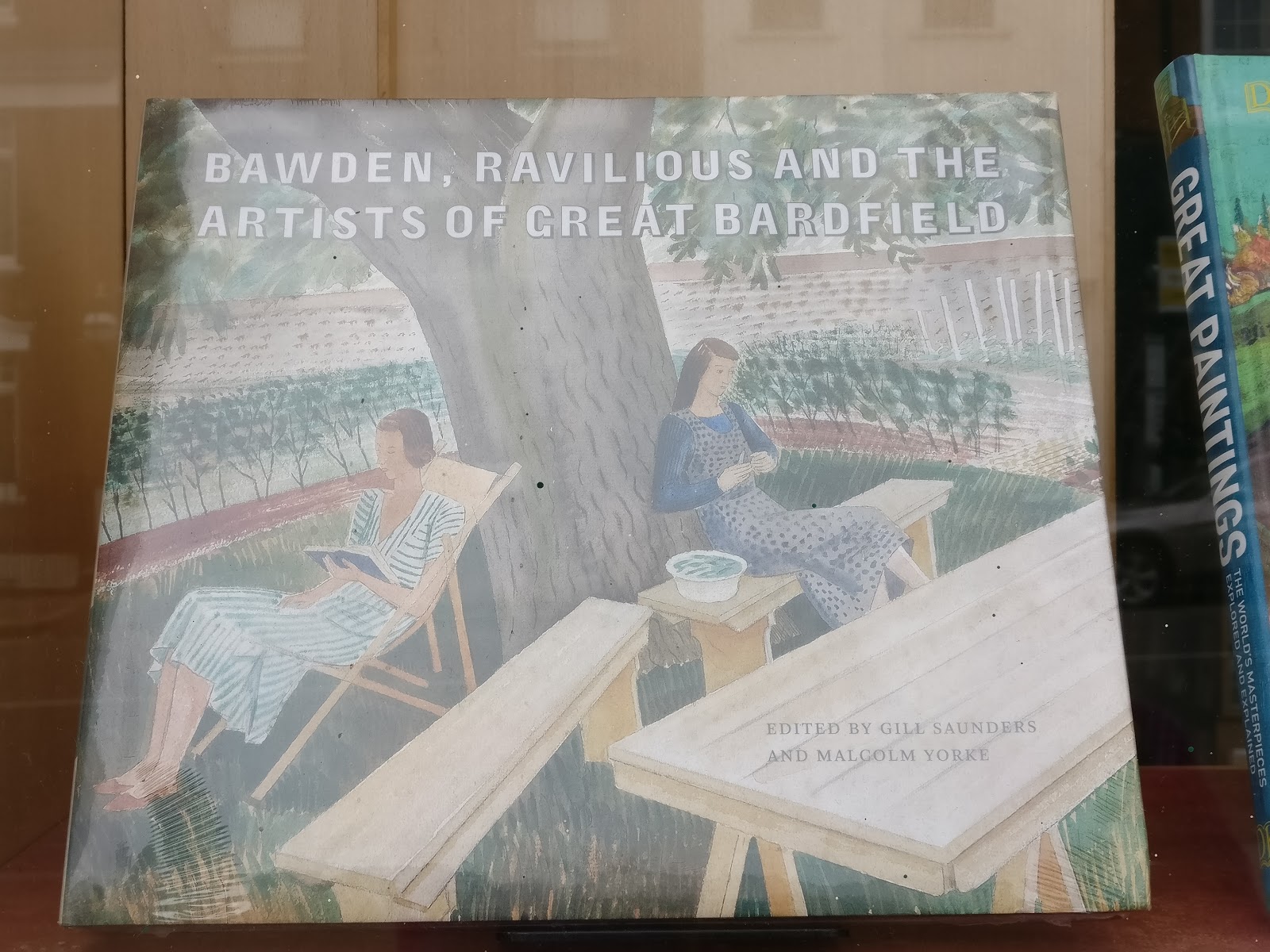
Wandering past a bookshop on a Sunday morning, I saw several books in the window display that might have come home with me if the shop had been open. (Narrow escape!)
So English!!

"exploring themes of Britishness, identity, craftsmanship and the art establishment"

How - and why - are women's self-portraits different
from men's?

"A spotter's guide to the British landscape"

The "medieval" book is wonderfully illustrated,
and I love reading essays

(Still re-reading His Dark Materials....)

Words by Robert MacFarlane (from his Landmarks), visuals by
Jackie Morris, who spent two years immersed in this "book
for all ages"

13 May 2018

Giorgio Griffa at Camden Arts Centre

The exhibition finished in early April; I went several times, the work really grew on (?in) me. A video in which the artist talks about the work, and his relationship to the materials, is here.

Lines and shapes of colour painted onto, or rather, into, unprimed fabric, which has been folded and retains those fold marks. Many works are large and fill the rooms of the gallery wonderfully. It was hard to stop taking photographs: each new angle was another spatial revelation.


Frammenti, a work from the 1980s, was reconfigured in response to the
architecture, atmospherics, and light of the gallery

The number used in these works from the early 2000s is the Golden Ratio


 Details -


When I revisited, just before the exhibition closed, I spent some time in the Reading Room, where books about Griffa's previous exhibitions were laid out.
This collage (?montage) of marks on transparent paper, exhibited at the XXXIX Venice Biennale (1980) caught my eye and imagination ... how, if at all, could it be done in stitch (and: why?) ....
Other works had been exhibited in a medieval palazzo in 1995 -

One of the books had text on the right-hand page, and a tantalising flutter of careful marks and colours on the left -
 In his studio! -
 A happy conjunction of fragments -
 Larger works, fitted onto the page -
 Fragments and overlays -

"Griffa sees painting as an unmediated experience of the physical world. Though often minimal from afar, his works invite intimate attention to the exacting behaviours of their materials, to consider the experience of pigment on canvas at a molecular level. ... The modest appearance [of the creased canvases] reaffirms their reality in material and temporal terms, while underlying each work with a geoetric grid."