Showing posts with label quotes. Show all posts

08 September 2019

Enduring thoughts

Finding things as I clear out a few drawers... this little book was my New Year greeting card as we entered the 21st century -


And there were more inside! -
Of those, my current favourite is from George Bernard Shaw -
We have no more right to consume happiness without producing it than to consume wealth without produing it.

08 February 2018

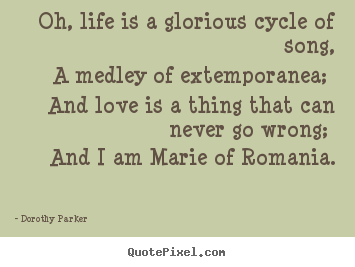
Poetry Thursday - a little something by Dorothy Parker

A quick poem ... lest Thursday pass unnoticed yet again ...

Type "Thursday poem" into the search engine, and what comes up? This (1925)-
Image result for thursday poem

Ah, Dorothy Parker, woman of wit and source of so many quotable quotes ...

14 July 2016

The purpose of technique

Quote of the day:

Giorgio de Chirico: “The purpose of perfecting technique is not for getting closer to the representation of the object, but, to the contrary, to detach it as far as possible, to make of it—its own object—a thing unto itself.”

Found, along with the etching below, in an article about Morandi and Bonnard, which calls Bonnard's paintings "patchwork quilts"!

29 May 2016

Old work - what's to become of it?

Once again these small pieces (6"x4") have surfaced. I can't quite seem to move them into the charity shop box...

These riffs on edifying mottos from samplers were made about 15 years ago, in a burst of wild spontaneity. Couching on scraps of silk dupion. The words are:

No one can make you feel inferior without your consent

What is unsought will be undetected

The appetite grows by eating

One day ... not just yet ... I shall take them out of the clip frames and use them for notebook covers. One day, when they can be united with a bagful of precut pages that are somewhere in this room and will emerge in the fullness of time (ie the two weeks remaining for it to be sorted out) - then the sections will be sewn together and the cover made. (The books to be given as presents, and found "too good to use"?)

The sorting out of my studio(s) brings up, yet again, that big question: what to do with old work? Finished work and samples both. What to do with it all when has it outlived its usefulness - and should it be disposed of just because it's no longer "useful"?

It's hard not to "personify" pieces of creative output - they become our children. Can we simply discard them? Yet, when drastically downsizing, what's the point of keeping all this stuff? For many of us, the greatest part of creative pleasure isn't the finished object, it's the process of making - of seeing the work evolve through our thoughts and under our hands. Rather like helping a child grow up. At which point they leave home ... our job is (almost) done.

Hmm, pursuing this comparison, I'm straying into confusing the work-as-child with the mother having outlived her usefulness. A murky area! But perhaps some of what keeps us from letting go of our old work is rooted in that emotional arena. An investment of time and energy and love, made tangible in the object. Which, if it no longer exists, is a personal loss.

Yet we do withstand losses. Less personal losses can be seen as trade-offs: remove extra furniture, however beloved, and gain necessary space. Give up the expensive holiday and you're able to use the money for something else. Everyday decisions; first-world problems.

So, there's this body of "old work" that no longer represents what you're interested in. Clean sweep, start afresh? One door closes and another opens?

Or hang on to it, "just in case"?


22 January 2016

Something Ellsworth Kelly said

46 Colours for a Large Wall (1951) (via)
Ellsworth Kelly died last year. I wrote about his early work in an essay a few years back and have a certain fondness for his work, even though the paintings are very minimal indeed, and I don't understand them and am not that keen on the aesthetic. Probably my fondness - or perhaps openness is a better word - is due to a combination of coming across a book with photos of where he lives, and his home, feeling very immersed in that;
(via)

and the story about him going to art school on the GI Bill and then being in Paris, painting those squares of colour for a few years ... that was a new experience for him, and it was new for me to come across it. So there's a conjectured link.

And this quote, which I found on Sheila's blog, links up for me too. I've condensed the full quote to make it more minimal ...

"My eye picks up things ... but I’m not searching for something. I just find it ... and it always surprises me."

The two important words that I've left out are "in nature" - "My eye picks things up in nature". Seeing again the landscape where he lives, the nature that surrounds Spencertown, makes it important to remember that the ... replace those words (as well as others). He also says of "nature" - "something that has the magic of life". 

From the Colour Squares he moved on to large shaped canvases in solid colours. And works on paper like this -
(via)
... which I feel I "understand" and find interesting to look at. Not looking for anything, but finding surprises.

And satisfyingly simple drawings of plants ... look here.

And this surprising (or maybe not so surprising) spatial drawing (via) -

19 October 2014

Mnemonics

Without writing things down, how do we remember?

The saying goes: I hear it and forget; I see it and remember; I do it and understand.

I heard birdsong and don't know what bird it is. I see artworks and sometimes remember the name of the artist. I follow a knitting pattern and get lost ... but once I understand the structure, I can look back and see where it's gone wrong. Different sorts of memory are at work, and  there are surely ways to enhance each of them.

One such is the phrase or sentence that helps us to remember lists - Roy G. Biv for the colours of the rainbow, for instance. Another method is to have a mental set of places and put objects in each one. Remember names by associating them with something meaningful to you. 

But what about the wider picture? In oral cultures, memory boards help to maintain and transmit historical knowledge. Someone who knows how to read them passes on the knowledge through a performance. 

Lukasa (memory board) in the form of a woman with a tortoise body. Luba culture, Congo (via)
"Lukasa, or memory boards, are hand-held wooden objects that present a conceptual map of fundamental aspects of Luba culture. They are at once illustrations of the Luba political system, historical chronicles of the Luba state, and territorial diagrams of local chiefdoms. Each board's design is unique and represents the divine revelations of a spirit medium expressed in sculptural form ... many lukasa utilize a system of denotation based on masses of shells and beads affixed to their wooden surfaces." (via)

" These wooden memory boards are used by Luba kings, diviners, geneologists and court historians in the Congo. The Lukasa is a memory aid, a means for evoking events, places and names which assist in initiation ceremonies. According to  A History of Art in Africa, "It stimulates thought and instructs in sacred lore, culture heroes, migrations, and sacred rule ...A configuration of beads, shells and pins coded by size and colour on one side refers to kings' lists. Beads may stand for individuals, a large bead encircled by smaller ones perhaps representing a chief and his entourage. Bead arrangements also refer to proverbs and praise phrases" as well as migratory paths and roads." (via)

" a great deal of ritual performance and ceremonial song is linked to repeating pragmatic and rational knowledge. This includes astronomical observations used to retain a calendar closely related to resource availability – be it from hunting, gathering or farming. Star patterns are often used as representations of mythological characters whose stories also encode rational knowledge." (via)

"Sets of locations in the landscape have been used as memory aids – the most effective memory aid known. ... the songlines of the Australian cultures, the sacred trails of the Native Americans and sacred paths found in cultures around the world served the needs of memory in exactly the same way." This is the method of loci, attributed to the Greek and Roman orators.

Medieval manuscripts too were designed as miniature memory spaces.
(via)
"In the Middle Ages, the memory arts changed purpose from the oratory of classical times to become the domain of the monks wishing to memorise great slabs of religious tracts. Monks were expected to memorise, at a minimum, all 150 psalms, a task which took somewhere between six months and three years.

"The heavily illustrated handwritten manuscripts were seen as a prompt for medieval memory when books were extremely rare and horrendously expensive. The words were enmeshed in images which match the classical recommendations for making information far more memorable: grotesque and violent acts along with fanciful beasts, strange figures, gross ugliness and extraordinary beauty. It was common to have each chapter start with a coloured initial, alternating between red and blue, with repeated letters each having their own design, such as in the Smithfield Decretal shown above."

To end, a contentious statement from the memoryspaces.com.au blog: "Art in oral cultures is primarily a memory aid to the knowledge system while art in literate cultures is primarily aesthetic."

13 October 2014

Found words

When you sort a heap of papers, does the categorisation tend to look like this at some point ... perhaps the point of maximum despair?
Then it all gets put away (what you don't see is the overflowing bin!) and it feels good.

Curiosities emerge, often on the backs of pages torn out of magazines. Here, I discovered the drawing of horses by Joel Person - and a puzzling little sentence in a 1990s review of some book about linguistics: "The genetic basis of language is illustrated by the existence of a family half of whose members cannot form plurals."
And then there are the wise words, heard on radio probably, that appear on scraps of paper. In this case it could have been a programme about scientists and creativity. Make of them what you will -

constraint - rules to rub against

opportunity kills creativity

the right limiting circumstances

purposeful distraction [freeing the unconscious the chug along and come up with solutions]

quieting the judging spectre

26 September 2014

Reorganisation progress in Studio136

...the studio formerly known as Cloud Cuckooland - I feel real hope that it will be a place of joyous work again. Already I have sullied the whiteness of the pristine worktops, by doing a big drawing, and when it comes to the sorting of materials I'm trying to be more ruthless - for instance, yesterday my stash of coloured tissue paper was halved. Whether what's left is really needed is a question for consideration "later", in Phase 2.

The hunt is on for the folded maps project that I worked on at last year's CQ retreat - I'd like to continue with it this year, and have two weeks to find the safe place where I put it...

So the plan is to take every box and bag out of every cupboard, to open every drawer - put them on the vast expanse of clear surface, and SORT, touching each bit of paper or fabric only once. Is this possible? ... we'll see...

Today I came across some unexpected things.

First out of the box was the maquette for a silk wall hanging I made sometime in the 90s and sold at a Cloth&Stitch show held at the TUC building - ah, those were the days! - but I don't have a photo of the finished piece. The bits of tissue are coming off the backing, and I'd like to resurrect this, develop it in some way -
Next to it was a lidded box, which revealed scissors and threads that had belonged to the mother of a friend. Three friends have passed on to me their mother's sewing things - an honour and a responsibility, and much cause for thought -
Somewhat crumpled and still in its wrapping, Winter 2010 issue of The Quilter. It had arrived while I was absorbed in family matters in Canada, so I had a quick look through, enticed by the detail from a quilt by Lena Wik of Sweden -
 ... and found this image of a quilt by Elizabeth Brimelow, one of my favourite artists -
In among the sewing things (why?), this beautiful bowl by Mary Vigor, bought at Chelsea Craft Fair in the early 90s ... I used to buy something every year, support living artists, that sort of thing...

A traditionally-made wooden box from a jumble sale a very long time ago - it was empty, what to keep in it? -
 A battered tin box containing a collection of sewing kits and a pincushion made for me by my pre-teen son. Apart from the pincushion, and even that's a "maybe", I'm ready to let go of this - any takers?
 The box has a vintage pic of the Royal Yacht Britannia -
 This next item was a surprise, and more cause for thought - it dates back to some workshop or other, definitely last century. Laying out the cards, I could see some I'd move to other categories now -
 Photos of my parents round about the age of 80 - my mother's hair never did go grey - and a note from "chocolate auntie" who sent parcels of Ritter Sport from Germany before it was available in the UK -
Silk bags made from a pattern in the Omiyage book ... and in the canisters, film rolls from the half-frame Olympus family camera, 1960s -
Another collection, from a 1995 trip to Moscow and St Petersburg - of Soviet toilet paper! -
Embroidery from last century - I took chinese characters and split them up, then embroidered the shapes solidly with silk threads. The presentation leaves much to be desired ... I'll rework these somehow -
In a basket behind a box, a collection of little clothespegs and lots of pins ... and some yummy beads -
At the end of the session, a happy feeling to see things put away but available when needed -
Two "secrets" of reorganisation: clear (see-through) storage, and labels.

Also found, a scrap of paper with this quote -

"Every creative act involves a new innocence of perception, liberated from the cataract of accepted belief." - A Koestler

28 June 2014

Daily painting project continues

... with just the one painting at the moment - and that singularity is a good thing (for now). I'm still channelling Bridget Riley* ... and through the ever-changing juxtaposition of colours, information about interactions is trickling into my subconscious. 

The painting process with the ever-changing stripes is about making bad choices and then being courageous and being patient, and redeeming the picture through adding unexpected colours and carrying on with more till it looks better - and it's about repeating that circular process with the next bad choice ("fail again, fail better").
Using a picture of a print by Gillian Ayres as source for choosing colours
Using the "colour dictionary" as a source for choosing today's colour
"Joke blue" and "ledger magenta" have been added, as have some more narrow stripes
However this fascination means I'm not following one of my rules - to try different things. Here are some possibilities for different things to try -
Wild strokes and zingy colours - but where, how to start?
(By Jesse Willenbring, via)

Sparse shapes, clean edges, patterning; different formats
(Pink Plant With Shadow #1 by Jonas Wood, via)
Painterly marks and brushstrokes
(Artist and title not given; via)
Denser, varied patterning; contrast of shape; letting the background show through
(Veilles maisons sur le bassin de Honfleur by Raoul Dufy, 1906; via)
What's needed is another kind of subject matter for a new evolving painting ... or a theme for a series - this is meant to go on for a year, after all. 

My hurried attempt with unfurling peonies from a bouquet of buds fizzled out when I missed some of the stages of their unfolding -


but it got me looking at "pink" more carefully, and using brushes in different ways. 


*Bridget Riley has a show in London (till 25 July) - on three floors of a gracious old building, it includes some of her "working drawings" as well as large paintings spanning her career. 


Experiencing the large paintings face-to-face is very different from seeing them in books or on screen - at different distances, the colours have strange effects. All of which has been carefully worked out via the drawings, and then painted by studio assistants. 

In a 2009 essay on her work and process in "The Eye's Mind" she says: "Although careful never to presume 'to know' what the pictorial elements would do in a particular situation, I began to feel that experience was fuelling my enquiry and that, whether I felt prepared to make some advance - or not - I had no choice but to do so." and "You cannot deal with thought directly outside practice as a painter: 'doing' is essential in order to find out what form your thought takes."


Previous incarnations of the stripey painting were shown on 10 May,  31 May, and 21 June.

11 May 2014

Something to ponder

Flipping through an art magazine over breakfast (as you do...) I started to read an article by Julian Opie, an artist I've never given a second glance. He's put together an exhibition of his art collection together with his own works, and the conjunction of portraits from the 17th and 18th century with his own sculptures and "graphic" works is ... interesting ...

But the sentence that most struck me was this:

"I make whatever seems suddenly possible with the tools I have to hand, tools of understanding as much as techniques of making."

It needs unpicking ...


  • the tools I have to hand - Opie works in paint, print, sculpture; his materials include LCD screens
  • suddenly possible - ah, the spark of insight!
  • tools of understanding - knowing about how the work fits into the world, not just the current world but in history
  • techniques of making - the choice of technique and the skill in its use


Of these, the "sudden possibility" struck me the most - haven't you had that wonderful moment when (usually after researching and pondering) the work to be made suddenly appears, in a few seconds -- you know what it will be (all the won't-be aspects have been discarded), but you don't know what it will look like or how it will happen...  Those (rare) moments are wonderful moments, the best there is.

Aniela bathing 4, 2013. Enamel on marble, 95 x 95 cm

The exhibition, 'Julian Opie Collected Works',  is at The Holburne Museum, Bath, 22 May to 14 September;, and Bowes Museum, Durham, 4 October to January 2015.

The article was published in Art Quarterly, Spring 2014; a draft is at julianopie.com. I've written about it ("When artists become collectors") for Ragged Cloth Cafe, but it's not available just yet, sorry!

02 April 2014

From the mouths of artists

Radio 3's The Essay recently had a series of Encounters with Artists, by art historian Martin Gayford, each a fascinating 15 minutes of listening: 
A decisive moment amid careful composition
Henri Cartier-Bresson, the prickly photographer who, interviewed at 93, had captured "the decisive moment" so many times;
Marina Abramovic the 'grandmother of performance art,' whose work has included lacerating her body, starving herself, living entirely in public in a gallery for 12 days and exchanging places for an afternoon with an Amsterdam prostitute; 
Robert Rauschenbergan artist whose paintings, 'combines' and graphic work anticipated pop art and many other genres, years before they became universally fashionable; 
Heron lived at Eagle's Nest, near the Cornish village of Zennor; the shapes in
his paintings echo those in the landscape (photo by Malcolm Osman, via)
Patrick Herona celebrated member of the St Ives School, who relished living amid the boulder-strewn fields in the specially luminous light of Cornwall; 

Euan Uglow, an uncompromising and difficult artist  who confessed not to be able to finish a picture, and whose sitters were obliged to commit to several years of posing.
Heron's window for Tate St Ives (1992-3) (via)
Patrick Heron on looking: "I believe that my awareness is saturated with visual pleasure. The greater the intensity of your consciousness, and visual intensity, the greater the pleasure" and he went on: "Looking is more interesting than doing anything else, ever, as a matter of fact." 

Rauschenberg on cooking: "It's a very social way to turn your back and still be there."
Rauschenberg with a White Painting in 1951 (via)
Rauschenberg had talked to Gayford about the very minimalist (all-white) paintings he made early in his career - or rather about his  "militant desire to be fair to paints. He hated the way that painters picked on innocent colours and forced them to express their emotions. He didn't think artists should make pigments or anything else express their feelings. This for him was a moral question. 'I found ... that the focus on the self, particularly through pity, was about the worst state, the most anti-life, that you could put yourself into.' He wasn't an abstract expressionist, he was an anti-expressionist."

He also said: "I want to surprise myself. I want to be the first one to not-know what I'm going to do next. I also want to be the first one to be confused and bewildered by what I did do next, after I'd done it."
One of Uglow's pears (via)
"Looking at the world is magic," said Uglow, and, in relation to his slow method of working, "It's only after a certain amount of time that you can really understand a form and find a way of sticking it down as a flat shape."
Marina Abramovic & Ulay, AAA-AAA, 1978 (video; via)
Abramovic's performance involved altered consciousness, almost entering a state of trance. "If I cut myself cutting garlic in the kitchen I cry," she said , "in private life you feel fragile, you are working from your ordinary self. When you are doing a performance you can use the energy of the public, which is enormous. You can push your limits further, and do whatever you want."

Why such frequent self torture? "Working with your body you have to confront your fears - fear of pain, fear of mortality - these are things of art that have always been there in different forms. If you work with the body you have to deal with them. What does the cut body look like? How far can you push the body's limits?"

I didn't have a chance to extract any pearls of wisdom from the Cartier-Bresson  episode  before it disappeared from the iplayer. (Some Essays are available as free podcasts - I recommend the one on Hildegard of Bingen.)