Showing posts with label science. Show all posts

16 April 2019

Drawing Tuesday - Science Gallery

This was our first visit to KCL's Science Gallery, in the shadow of The Shard. Was it the minimalist environment that took some getting used to, or was it the combination of science and art?

I found the exhibits in the "Spare Parts" exhibition interesting and thought-provoking, with "mediators" on hand to answer questions and offer to print out 3D body parts for the kids, eg a tooth. The 3D printing, even of small objects, takes a surprisingly long time!

Intrigued by the evidence of the printing process - those fine lines -
I  wondered if these printed-out body parts were child-sized or adult-sized -

as big as a fist

the vertebra were awkward....


Janet B also tackled the body parts (surely that's an aorta?) -
 "The thing" proved popular - it's called the Microbiome Replacement Incubator (explained here) and looks a bit like this -
Jo's rendition -
 Janet B's -
 .. and on the right, Janet K's, along with views of a human larynx -
 Judith preferred the glassy-ness of a collection of beakers -
 Carol took on the spikiness of cacti, juxtaposing them to a hellebore drawn elsewhere -
 Sue focussed on glass sculptures of artificial kidneys
 and then on part of a 3d mural showing the individuality of human hearts -

Tool of the week - water-soluble Woody pencils -

04 February 2019

Voyager - to Uranus

These images are from a Sky at Night programme from 1986, when Voyager 2, which was launched in August 1977, had travelled beyond Saturn to this distant "ice giant" (temperature about -216 degrees). (Watch it and others on the BBC iplayer, here.)

Uranus has a small rocky core, but mostly consists of a hot, dense fluid of  water, methane and ammonia. It orbits the sun every 84 years, and rotates on its axis every 17 hours.

Interestingly, its axis is perpendicular to its orbit - the "hot spot" in the image is the south pole - and even more interestingly, because of the retention of heat by the atmosphere, and convection in its fluids, the temperature is much the same as at the north pole. The magnetic axis is tipped at 55 degrees from the axis of rotation, and the magnetic field is about a third the strength of Earth's - the planet's fast rotation creates a dynamo effect. 
Images show that Uranus has banding - the red spot is the south pole
The "donut" circles in the images are artefacts, due to the camera, and the pink crescent is an artefact of a different sort. The colours arise from the different filters used in separate photographs, for each of which the radius is different; combining them leaves "bare areas" around the edge -
 Special methane filters were used to look at the atmosphere. The blue crescent indicates the area of the planet that's free of high haze layers; the red ring shows areas of haze around the equator -
The atmosphere is now known to contain hydrogen, helium, and a little methane.
It was known from telescopic observation that Uranus had five moons, and Voyager discovered two more; now, it is known to have 27 moons, all named after characters in the works of Shakespeare and Alexander Pope.
Miranda "has canyons like Mars, grooves like Ganymede,
and compressional forms like Mercury" - a range of terrain

Umbriel has an old surface with very large craters

Titania has small craters and lots of rifts

The first picture of the 9 rings - some have "shepherd satellites" that
keep the fine particles of the rings organised

A longer exposure (96 seconds) in scattering light;
the long specks are due to the length of the exposure
as Voyager sped past at about a million miles a day,
50,000 miles above the planet

Next planet: Neptune
Having visited four planets,Voyager 2 is now - more than 40 years after launch - beyond the solar system, in interstellar space, having visited Neptune in 1989. The last solid body it studied was Neptune's moon Triton. It's travelling at 470 million kilometers a year, and Voyager 1, which visited Jupiter and Saturn, has also left the solar system, travelling 520 million kilometers a year on a different trajectory.

In those four decades, technology has made leaps and bounds - state of the art in 1986 still included computers with green screens, remember those? Digital manipulation - making false-colour images - took "a day or so", partly because of the low light levels at that distance from the sun.

29 March 2018

Poetry Thursday - Edna St Vincent Millay, on an age of science

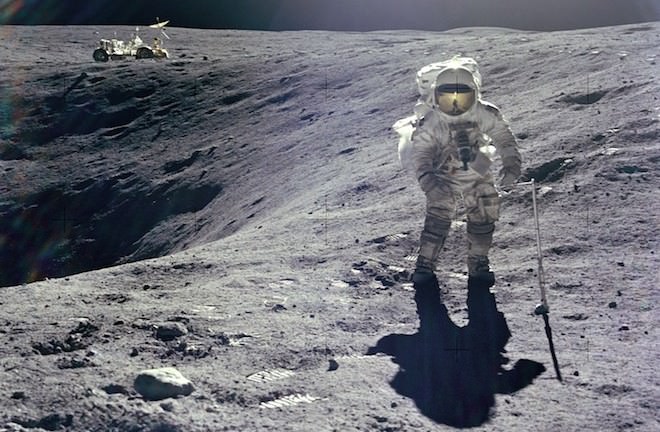
Astronaut Charles Duke collecting samples during Apollo 16. Credit: NASA.
"To wake the moon with footsteps" (via)

Upon this age, that never speaks its mind,
This furtive age, this age endowed with power
To wake the moon with footsteps, fit an oar
Into the rowlocks of the wind, and find
What swims before his prow, what swirls behind ---
Upon this gifted age, in its dark hour,
Rains from the sky a meteoric shower
Of facts . . . they lie unquestioned, uncombined.
Wisdom enough to leech us of our ill
Is daily spun; but there exists no loom
To weave it into fabric; undefiled
Proceeds pure Science, and has her say; but still
Upon this world from the collective womb
Is spewed all day the red triumphant child.

-- Edna St Vincent Millay


Tangentially, in the words of American entomologist and biologist E.O. Wilson (born 1929):

We are drowning in information, while starving for wisdom. The world henceforth will be run by synthesizers, people able to put together the right information at the right time, think critically about it, and make important choices wisely.

08 May 2017

A weekend of science, part 2

The Imperial College Festival of Science is in its third year. It has a huge programme all over its South Kensington campus, showcasing what faculty and students are researching -
For instance, microwavable cutlery - warm cutlery and warm hands make children eat more slowly, which is a good habit to have -
 Here's a week's worth of fibre - the optimum being 30g a day -
 but in the UK the average intake of fibre is only 11g.

Science and art - how environmental changes - eg urban lighting - would change the look of some famous scenes, such as this starry sky by Van Gogh -
Unfortunately the caption neither helpful nor accurate - "...effects of increased urban light pollution. Paris is of Europe's most light polluted cities with further intensification preventing astrological [!!] observations and artistic impressionism."

But that is a mere quibble. Thousands of people - 15,000 last year - were taking part, enjoying themselves, and learning "science stuff".
I now know a bit more about lipids, glycans, and schistosomiasis, and that cells have a coating of sugars, like m&ms ... but far, far more complex ...

Everyone likes to know about fire. Here's why the Old St Pauls cathedral caught fire in 1666 - broken tiles on the roof let embers fall on wood, which burned - whereas if tiles are in place, the embers don't catch hold -
 And then there are Fire Whirls, aka fire devils, fire tornadoes, etc -

A weekend of science, part 1

"Introduction to Rocket Science" was organised by the British Interplanetary Society (the world's oldest space advocacy organisation) and held at the Royal Institution; the library was used as one of the lunch rooms -
What a great day, with 14 sessions about space, satellites, earth observation, the future - and very little of that off-putting mathemtical stuff, much more about people's personal stories and involvement.

Rocket-launch ties and starry waistcoats were in evidence -
 as well as NASA teeshirts in the audience (and one little girl wore her astronaut costume).

The first big surprise was a gorgeous model airplane, used to demonstrate the principles of flight. During his 50 years as an aerospace engineer, Bob also made model planes of his own design. The one he's holding weighs all of 2 grams -
so not much energy is needed to get it airborne -
Before lunch we learned how to build a spacecraft - or rather, about what's involved in a team building a spacecraft; found out how many satellites it takes to provide worldwide coverage (Oneweb will use about 800 to provide global internet coverage); saw a satellite image that just about showed a person moving - and voted on whether to send humans or robots into space (opinion was split). That and more before lunch.

After lunch, a quiz chaired by Stuart Eves got us to our feet and putting hands on heads or bums for answers "higher" or "lower" for answers to questions like: "The moon is moving away from earth at 4cm a year. Since Neil Armstrong walked on it, has it moved more or less than his height (180cm)." How stressful is it to do mental arithmetic in public! Get it wrong and you have to sit down, eliminated.
I was one of five who lasted to the penultimate round - last woman standing. The moons of Jupiter were my downfall - more than 60, or fewer?

Involving the under-12s - Mars Rover engineer Abbie Hutty gave them balls of various sizes for Earth, Moon, Mars - and a speck of dust for a satellite - and arranged them by relative distance - the satellite 50cm from the centre of the football, the moon 5 metres away ... and Mars (the girl in the astronaut overall) would be in Hyde Park -

Next up, exoplanets and aliens - the Drake equation estimates that about 20,000 technological civilisations have existed. Wow.

It's always a good idea to have a Real Live Astronaut in attendance - Cady Coleman told us about her life in space - 159 days in total - and back on earth -
Not many people get to see this happening in front of their eyes
Quote of the day: "Things change when you have a different way of looking at them." What would it be like to spend time off-earth?

Why explore space, though? Two reasons: to get above the effects of the atmosphere; and, to go to "interesting places" - such as sending probes to Venus found that under its clouds the air pressure is 90 times that on Earth, and the temperature is about 700 degrees. Not somewhere for humans to live, then. And Saturn's rings are "a natural laboratory for gravity".

The James Webb Space Telescope is one of the next big things (remember the excitement of Hubble, launched 27 years ago?). The JWST has an enormous sunshield and a huge mirror made of hexagonal mirrors that have a grid of tiny holes, allowing them to deform slightly (interesting; but I've forgotten why this is necessary). Due to launch in 2018, it will be looking at "old light" and sending 235 gigabytes of information back to Earth each day, ie lots and lots and lots of data.

Another next big thing, at the other end of the size spectrum, is cubesats, made possible by shrinking technology. They measure 10x10x11cm and the units can be linked into arrays. All those little things whizzing round the planet - surely there are collisions?

At the end of a long day, the final talk was titled "We're doomed!" and when you're tired, that's not what you want to hear. But the message is more hopeful - yes, one day a big "near earth body" will hit us, and we don't know when, but bear in mind that 100-150 tonnes of stuff from space (mostly dust) hits Earth every day, and that there's an inverse relationship between the size of the object and the frequency of hits.

The day ended with a bang of a different sort: a giant participatory "experiment" in the famous Faraday Lecture Theatre, where, amid glorious pandemonium, the balloons we'd written our names on and blown up went whizzing round, hoping to land on the prizes laid out on the floor -
I got lucky! -
Published in 1967; price 24p


09 February 2016

Drawing Tuesday - Science Museum

On the way to the gallery, I spotted the engine of a V2 rocket, visible "in the round" -
Since struggling to draw it at the Imperial War Museum a while back, and again at the weekend, I was interested to get a different view of the pipes - but rather than stopping to draw it, proceeded to the gallery as planned.

Only to find this -
To get the angle (and to fit it on my page), I sat on the floor - and did lots of measuring, until it actually did fit on the page, with a little space to spare at the top, fortuitously as it turned out. Meanwhile a tour came round and I learned that this V2 rocket had been built after the war, by the British. Elsewhere it says it was one of eight engines built as part of Operation Backfire in late 1945, and came to the museum via Cranfield University. It has been standing upright since 2000.

Getting up to stretch, I went round the back and saw the bit that didn't fit under the ceiling -
and added it to the drawing -
The shadows helped with seeing the details, as did having brightness from the sunshine -
 Using the camera helped with a better view, too -
As the tour guide said, if these bombs had been developed earlier in the war, there's not telling what would have happened - once launched, they were unstoppable. After the war, the V2s became the basis of the space race, their scientists and engineers relocating to the US and the factories being taken over by the Russians.

History aside, here are some of the day's drawings.
Blind drawing by Sue M - 1868 steam train - such energy!

Lighthouse light - left, by Michelle; right, by Sue M

Budding's patent lawnmower, by Sue S

Janet B's final drawing: Nasmyth reflecting telescope, 1852
 
Carol caught the metallic gleam of the Lockheed Electra airliner

Gallery overview