Showing posts with label journal quilts (12x12). Show all posts

28 December 2009

Journal quilts, 2009

Contemporary Quilt's journal quilt project for 2009 is drawing to a close. The deadline for the final four quilts is 31 December. Thanks to two days of quietly hand-sewing while listening to the radio (bliss!) mine are ready, with several days to go.

September - fruit moon; October - falling leaves moon; November - frost moon (version 1 in the making); December - long night moon -And here are the final versions - I decided to start November again, after a little research on how frost crystals form -
I'm pleased with the Novemberand December quiltlets (6" x 12") -You can see the earlier JQs here and here.

28 September 2009

Earlier moons

January - Winter Moon - the moon is a hole, with the thready branches passing over it. Of course all that machine stitching caused a lot of puckering of the unstitched background. Lesson learnt.

February - Snow Moon - this was fast - simply dots on grey organza, and a few french knots.

March - Crow Moon - what does a crow look like, when you want to cut one out of fabric? This is what got me drawing crows, and interested in crows.

April - Egg Moon - this one cries out to be redone, even though that was the last of the fresh green linen (recycled from a shirt).

And then Flower Moon and Rose Moon, as in the earlier post. Onward, to the final journal quilts of the year!

11 September 2009

Journal quilts

Because of going to Canada and then the Festival of Quilts - and then picking up the pieces! - I got a bit behind with the latest batch of journal quilts for the Contemporary Quilt challenge. This year they're 6" x 12", and I'm using the theme of the moon - based on folkloric names of the different months.
So here we have May - Flower Moon; June - Rose Moon; July - Thunder Moon; August - Grain Moon. The first two have a lot of hand stitching - couching, stem stitch, french knots - and the final one uses fancy machine stitching, which took much longer than I thought it would! Thunder Moon might look "thrown together" -- it is in reality a resonant amalgam of considered juxtapositions (translation: bits from my scrap bag that I quickly auditioned, and went with gut feeling).

imho the quilts should help "move you on" somehow, whether trying a new technique, combining new colours, using different sorts of fabrics - but how are these moving me on ...

First of all, working with the one theme all year - and having at least the moon shapes "fit together" so that the total will be a frieze. Learning point: plan the colours too!

New techniques? May is backed with a flower print, and I put down the coloured fabrics on the front before machining round the flowers on the back, then cut back the fabric. The black edging is hand couched - a narrow zigzag on the machine didn't work out.

July - how to quilt thunder? I thought a series of boxes that sort of grew out of each other - but when the fabric hit the machine, that turned into a sort of greek-key design, rolling across the sky.

August - I idly asked Tony how he'd represent a "grain moon" and he thought of loaves of bread made from grain ... flour ... mills -- so that's why the moon is quilted like a millstone! The ears of grain are done in various variegated threads, over layers of sheer fabrics, sort of like the "clouds" in Thunder Moon. The sheer layers, and the shapes of the "ears of grain", reminded me of the "Fantasy Forest" pieces I was making ten or more years ago -
very fiddly, all those little bits of fabric!

28 August 2009

CQ at FOQ

CQ was represented at the Festival of Quilts by its stand, with coordinator Ali Mesley in almost constant attendance, here joined by newsletter editor Irene Macwilliam. The display is of the Celtic Connection quilts made by members for the Guild AGM in 2009.Near the cafeteria area, CQ had a display of a selection of the 2008 journal quilts - of the 12, you had to choose four for display -
These are by Jackie Ingram and Briony Askew -
mine and Jennie Wood's -
And these are by Julienne Hanson and Hilary Gooding
The 2009 journal quilts measure 6"x12".

22 December 2008

"Thorns in their side"

The fabrics are printed with one of my favourite stamps, cut out of sticky-back foam - the paints are Liquitex and an irridescent acrylic, which works well on dark fabric -
The quilting emphasises the spiky outlines and adds some colour in the grey area. The red bits on the bottom are printed on interfacing, or maybe it was a bit of lutradur, and appliqued.

22 November 2008

Now what?

Sometimes you think "what was I thinking"... This started as a recyled silk blouse, with red and pink filling in what used to be armholes and other missing bits. Then, what other scraps were to hand? I must have had some idea underlying all this -- pennants / penance, perhaps? -- or, blowing in the wind?

Some things just don't gel. There comes a point when you realise it's not going to work. I'll do the quilting, if only for practice, but it's not saying anything to me at the moment...

14 November 2008

Transition - three more

These 12" square JQs are silk, bonded on, then closely quilted - first, "Sorting" -then "Off Kilter" -
And "In a Spin" - which uses teeny tiny scraps, already with bondaweb, left over from cutting circles (just couldn't bear to throw them out; knew they'd be useful sometime...) -

28 October 2008

Transition series

A story is developing. Recently we had "Going Around in Circles" - here it is finished -
Now it's "Starting to Fall into Place" -I'm "Getting Ready to Play" -
Looking forward to release! "Out of the Box 1" -Hoping for an explosion of creative opportunities! "Out of the Box 2" -

16 October 2008

Something pink and round

The journal quilt for this month is taking shape. Perhaps inspired by seeing Jean Littlejohn's work at the Knitting & Stitching show, I felt the need for circles. (This pic of Jean's work is from the 62 Group website - her work shown at K&S, especially the Pathways series, is even more yummy.)And now my little thing (rather close up), front -
and back -
Its title might be "Going round in circles" - or it might be "In the pink" ... or maybe "Giant gooey marshmallows"? ... there's still a bit to stitch and the edges to finish.

27 August 2008

Finished at last

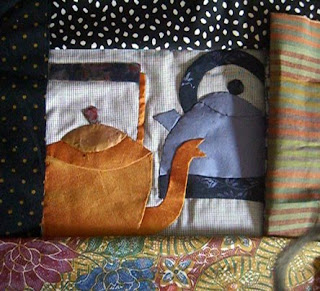
Borders decided, quilted, and bound, on a journal quilt started a while ago. The quilting has made the kettles look a bit battered. Something to watch out for next time.

11 June 2008

Kettles again - and thoughts about planning quilts

Thanks to everyone who gave input on what to use for the borders of the little kettle piece. Your input really got me thinking, especially because there was no unanimous choice. So I went back to the stash and chose these.The fabric on the bottom was once a tablecloth that was once used on the boat, where the copper kettle lives. (And before that it was intended as a sarong.)

The borders are now securely attached, and today while stewarding at the London Quilters exhibition (which you can see, quilt by quilt, here) I started quilting them.

This piece is evolving step by step; I woke up one morning with the idea, and got on with it, and am enjoying seeing it develop.

Some people advocate doing all the planning before starting any of the hands-on stuff. In her article in the Summer 2008 issue of the SAQA Journal, Brett Barker advocates doing multiple sketches: "If you can manage to do three or four sketches, you will find that your idea will refine itself without any conscious thought at all." When her "creative" brain has come up with a final sketch, her "thinking" brain can make fabric choices: "Doing preliminary work through sketches allows me the freedom to create without stress - the hard part is done. I can now sit back, relax, and watch my idea realize itself in thread and fabric."

Sounds like a good way of working - or is it a counsel of perfection? Elsewhere I've heard people express horror that some people don't draw anything out before starting a quilt, don't use sketchbooks, don't spend "enough" time planning. Is that always so bad? Is it a Golden Rule to spend 50% of your time doing the planning? Consider the oriental method of working: visualise the result and then do the work; if the outcome seems good, put it away for a few months, then reconsider. Yet another approach is to "act like an artist": do something, and respond to the outcome.

Which of these is (or are) the most appropriate for something as labour-intensive, and as drawn out, timewise, as a quilt?

There are probably as many ways of doing the creative work for a quilt as there are artists making quilts. But let's hope there aren't "design police" ready to lay down the law on this - there are already too many "quilt police" busy inspecting the finished items.

18 May 2008

More hexagons

Nearly gave up on this one - the individual hexagons took forever to cut -but evenutally they were all pinned in place
and then held down by little cross-stitches, some yellow, some orange -
At last, time to put it under the machine -
Then, french knots added to intersections where there weren't already cross-stitches:
Finally, the narrowest binding possible, 1/4" of doubled black sheer. Next time, I'll add a layer of tulle before machining. But as this was so fiddly, a "next time" is in doubt!

16 May 2008

Hexagons - endless chain

The new stamp went to work on some silk dupion. First step, once the stripes were together, was to delineate the hexagons with hand stitch. Next, I machined all the daisy/star shapes, then added a narrow binding (in the fluorescent orange) round the back.
It didn't photograph terribly well: you don't get the wonderful shine of the "metallic" orange bit, or the limeyness of the green. But while making it I had various ideas for other uses of hexagons.

30 April 2008

Journal quilts again

Here are a couple I made earlier - above, trying to convey the pleasurable feeling of warm soapy washing-up water; and below, a rainstorm -
The rainstorm started with a monoprint on the splodgy dyed fabric (a black dye that separated out into component colours), and the grasses are two different threads on the top layer, rather than the colour being changed by the dark overlay. And you're right, I should have been more careful with getting the gold piece straight....

20 March 2008

A few more moments' work

Back in January I started this journal quilt, and even did a few stitches on it while on the plane. At last, with added handstitching and quilting, and a satinstitched edge, it's finished:
Rather than replicating the 9th century Mesopotamian bowl that inspired it, this piece makes me think of a big splash - and the "cuneiform" elements in the middle are more like sharks' fins than a writing system. Hmm, something for next time perhaps....

Also for next time: either make the quilting look perfectly regular, or perfectly irregular - there's to be no hugging of the middle ground of sloppiness in this. And I'd like to try some more french knots used as quilting.

18 March 2008

Heartbeat

This 12x12 is "on the wall" at my desk - I keep looking at it, hoping to see what it needs now... it doesn't feel quite finished ...

26 January 2008

The work of moments

Dijanne's post on Xenobia sent me looking in a book of near-eastern art and while flipping through I saw this 9th century bowl from Mesopotamia -and thought "if I had all day, I'd use this as a starting point..." -- and then thought "I don't have all day but I do have 30 minutes!"

So, off to the sewing room, pull fabrics, and get going cutting - first in separate "leaves" and then trying to get the entire palmette out of one shape. The way you paint on pottery and the way you cut out of fabric are Very Different Things!
This certainly won't look like a bowl when it's done -
That'll do for palmettes, let's get on with the central bit.
"Translating" the writing was tricky, but I was running out of time, so this will have to do. It can be rethought and reworked - or rather, changed by adding "something" - later.

And "something" is needed in the bottom corner - these are the fabrics that came to hand first. I left this to percolate in the subconsious during the work day.
Next steps - that corner; raw edge applique; some handstitch in the central section; the quilting of course; binding. That'll certainly take more than half an hour, but sometimes the hard part is actually getting started.

Gluestick is great for working fast like this.