Showing posts with label poems. Show all posts

25 May 2021

Drawing Tuesday - fruit & veg

 Ah, fruit and vegetables, that old favourite, such a good standby... but infinitely various!

A still life, possibly.

A cross-section, possibly.

A heap, possibly.

A pattern, possibly. 

Tonal? Colourful? Pencil, pen, watercolour, coloured pencils, felt pens....


From Sue K - Here is my piece for the day: a water melon miasma in pastel. 


From Richard - Trying to avoid detail and let it flow but nearly gave up when I saw Judith’s onions before I started - absolutely lovely.


From Judith - Quick contribution as out meeting friends for lunch, hurrah!


From Carol - Inspired by a highchair.


From Najlaa - This is my drawing of lemons. I have really enjoyed this week's theme because I love lemons!


From Joyce - I might not get around to painting this week but here’s one I did recently!


From Gill - Blueberries. A collage using an old drawing.


From Janet B - A colourful pineapple. Drawing this afternoon has been an enjoyable displacement activity for my long list of domestic chores. 


From Sue B - a couple of sketches of gorgeous red apples… they reminded me of a poem written by a good friend, a chilean refugee poet called Maria Bravo…

I want to eat
a big red apple
tasting healthy
in its special apple way

I want nothing else today
just to eat an apple
not thinking
anything as I

sit on a wall
swinging my feet, 
watching
the world go by.

That’s all.
Happy to be
me
with my apple.


From Janet K - Fruit and veg for tonight's supper.


From Mags -  No time for drawing yesterday as I had my first trip to London since March  2020. So in Photoshop I altered photos  of the monstrous  (but delicious) local strawberries  from the market. 


From Sylvia -


From me -  an imperfectly-remembered illustration seen at the Shirley Sherwood botanical illustration gallery at Kew Gardens led to this attempt at reconstructing what was a citrus fruit, originally delineated in two panels printed on separate pages, to fit the Japanese book format -


28 January 2021

Poetry Thursday - Reading Laozi by Bai Juyi


Picture of Bai Juyi from the book "Wan hsiao tang"


Reading Laozi
Bai Juyi

Those who speak do not know, those who know are silent,
I heard this saying from the old gentleman.
If the old gentleman was one who knew the way,
Why did he feel able to write five thousand words?


Bai Juyi (772-846; also known as Bo Juyi and Po Chuyi) wrote in the Mid-Tang period, living through the reigns of eight or nine emperors. A government official, his social and political criticism led to getting into official trouble, and subsequent exile, several times; he lived in "interesting times". 

One of the most prolific of all Chinese poets, Bai Juyi is best known for his short occasional verses written in simple language. Hei wrote over 2,800 poems, which he had copied and distributed to ensure their survival. They are notable for their relative accessibility: it is said that he would rewrite any part of a poem if one of his servants was unable to understand it.

His best-known poems are indexed on this site, appearing in characters, pinyin, and literal and literary English translation.


*Laozi (Lao Tzu, Lao-Tze) was an ancient Chinese philosopher and writer. He is the reputed author of the Tao Te Ching, and the founder of philosophical Taoism.


21 January 2021

Poetry Thursday - The Sick Rose by William Blke


O Rose thou art sick.
The invisible worm,
That flies in the night
In the howling storm:
Has found out thy bed
Of crimson joy:
And his dark secret love
Does thy life destroy.

     - William Blake (author and artist)


The meaning of “The Sick Rose” is hotly contested (see here, and elsewhere, for the academic battlefield). 

The poem has been set to music by various people; my favourite is Benjamin Britten's setting as "The Elegy" in his Serenade for Tenor, Horn, and Strings. Several versions are available on youtube, this one with a nice moonlit seascape to add further mood. A version sung by Ian Bostridge is here


24 September 2020

Poetry Thursday - I Have Loved Hours at Sea by Sara Teasdale

I Have Loved Hours at Sea

I have loved hours at sea, gray cities,
The fragile secret of a flower,
Music, the making of a poem
That gave me heaven for an hour;

First stars above a snowy hill,
Voices of people kindly and wise,
And the great look of love, long hidden,
Found at last in meeting eyes.

I have loved much and been loved deeply --
Oh when my spirit's fire burns low,
Leave me the darkness and the stillness,
I shall be tired and glad to go.

Sara Teasdale (1884-1933)


Born in St Louis, Mississippi, Sara Teasdale was the child of older parents, with teenage siblings, and her first word was "pretty". Throughout her life she was frail and sickly. She was homeschooled and had no playmates of her age till she was ten. The first of many poetry collections was published in 1907. She married in 1914, divorced in 1929, and lived the rest of her life for her poetry. She caught pneumonia in 1933, which weakened her not only in body but in spirit; she committed suicide in New York city that year.


23 July 2020

Poetry Thursday - spotted in transit


I am the Song

I am the song that sings the bird.
I am the leaf that grows the land.
I am the tide that moves the moon.
I am the stream that halts the sand.
I am the cloud that drives the storm.
I am the earth that lights the sun.
I am the fire that strikes the stone.
I am the clay that shapes the hand.
I am the word that speaks the man.

- Charles Causley  (1917-2003)


Seeing this poem lifted my mood during my first journey on public transport since lockdown, my only journey (so far) since 23 March.

Mention of another poem by Causley, the much-anthologised Timothy Winters, appears in a Poetry Thursday post about The Knee by Christian Morgenstern.

On this site, Causley reads several of his poems, including The Ballad of the Bread Man, a poem not just for Christmas.

16 July 2020

Poetry Thursday - Still Life with Sea Pinks and High Tide by Maura Dooley

What joy to be reunited with Poetry on the Underground! This was spotted on the Overground, on the two-stop journey home from Gospel Oak after an uphill amble to Kenwood, the cafe, and a coffee in the garden.


Still Life with Sea Pinks and High Tide

Thrift grows tenacious at the tide’s reach.
What is that reach when the water
is rising, rising?
Our melting, shifting, liquid world won’t wait
for manifesto or mandate, each
warning a reckoning.
Ice in our gin or vodka chirrups and squeaks
dissolving in the hot, still air
of talking, talking.

Maura Dooley (b.1963)

Hear it read here.

09 July 2020

Poetry Thursday - Urgent by Sheila Wingfield

(via)

Urgent

Villages pass under the plough
In England, where there was plague,
And lets time slide over parishes
The way hedges are torn out.
Bulldozers flatten a hill:
Even continents slip.
Everything must elide or kill
As the wild aurochs died.
And our elms. We have
Barely a minute now.

Sheila Wingfield (1906-1992)


Because both her father and husband disapproved of her interest in literature and poetry, it was only after her husband's death in 1973 that Sheila Wingfield was free to write openly. As a child she educated herself by secretly reading a literary classic each night and writing verses in the early morning, and during her marriage she wrote her poetry between 3am and 7am. She inherited and renovated two large houses in Ireland, and wrote three volumes of memoirs and seven books of poetry.

02 July 2020

Poetry Thursday - Beech by Elizabeth Jennings


Beech - Elizabeth Jennings

They will not go. These leaves insist on staying.
Coinage like theirs looked frail six weeks ago.
What hintings at, excitement of delaying,
Almost as if some richer fruits could grow
If leaves hung on against each swipe of storm,
If branches bent but still did not give way.
Today is brushed with sun. The leaves are warm.
I picked one from the pavement and it lay
With borrowed shining on my Winter hand.
Persistence of this nature sends the pulse
Beating more rapidly. When will it end,
That pride of leaves? When will the banches be
Utterly bare, and seem like something else,
Now half-forgotten, no part of a tree?

(via)

Elizabeth Jennings was born in Boston, Lincolnshire in 1926, and lived most of her life in Oxford, where she moved in 1932. She was educated at Rye St Antony and Oxford High School before reading English at St Anne’s College, Oxford, where she began a B.Litt., but left to pursue a career in copy-editing in London. Returning to Oxford to take up a full-time post as a librarian at the city library, Jennings worked briefly at Chatto and Windus before becoming a full-time poet. Her second volume of poetry, A Way of Looking (1955), won the Somerset Maugham Award, which allowed her to travel to Rome, a city which had an immense impact on her poetry and Roman Catholic faith. While she suffered from physical and mental ill health from her early thirties, Jennings was a popular and widely read poet. She received the W.H. Smith award in 1987 for Collected Poems 1953–1985, and in 1992 was awarded a CBE. She died in Rosebank Care Home, Bampton, in 2001 and is buried in Wolvercote Cemetery, Oxford. (via)

Poetry Thursday - A Portable Paradise by Roger Robinson

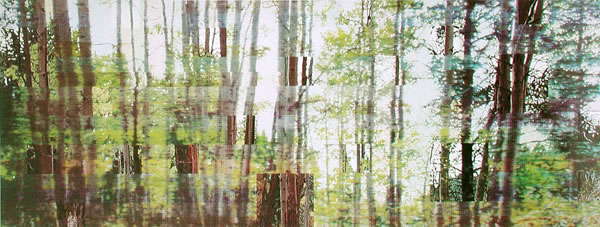
"... its piney scent ... "    Clearing by Dan Hays (via)

A Portable Paradise by Roger Robinson

And if I speak of Paradise,
then I’m speaking of my grandmother
who told me to carry it always
on my person, concealed, so
no one else would know but me.
That way they can’t steal it, she’d say.
And if life puts you under pressure,
trace its ridges in your pocket,
smell its piney scent on your handkerchief,
hum its anthem under your breath.
And if your stresses are sustained and daily,
get yourself to an empty room – be it hotel,
hostel or hovel – find a lamp
and empty your paradise onto a desk:
your white sands, green hills and fresh fish.
Shine the lamp on it like the fresh hope
of morning, and keep staring at it till you sleep.


Sent by a friend as "a poem for today in every sense"

23 January 2020

Poetry Thursday - found on instagram


So visual. Such a picture from my own Canadian childhood - my family were immigrants, though there was no grandfather, and we only passed through Montreal on the way west to Vancouver. Growing up, there were many neighbours from other parts of the world, and England - the other side of the world, it seemed - was for me one of the exotic places. Now I live in England! As I get older even the familiar places are starting to reveal their exotic undercurrents, things to make you wonder.

16 January 2020

Poetry Thursday - Japanese poems about fish

Katsuo Fish with Saxifrage by Hiroshige from the Metropolitan Museum of Art

Bonito (katsuo) and saxifrage (yukinoshita [雪の下]) by Hiroshige (via)


Fresh bonito tastes best
when you let it melt in your mouth
under the snow of Kamakura
Toshihiro Machikado

(The phrase “under the snow,” is the literal translation of the name of the plant below the fish, saxifrage.)


I found the translation of the poem that is written - or rather, carved and printed -on Hiroshige's print while researching Hiroshige's Shoal of Fishes, published in the1830s in response to a request from the Kyokashi poetry guild for prints to accompany ten poems. So really the poem is more important than the fish - or at least the poem preceded the fish.

The article from which this comes also gives the translation to another poem, by Haruzono Shizue, about trout - or rather, it gives three translations, some more "poetic" than the others.

09 January 2020

Poetry Thursday - Thomas A. Clark


A lovely book of (camera-less) photographs by Susan Derges and text by Thomas A. Clark.


the children are building
a raft to drift
gently down the stream
pale faces blossoming
briefly among
marsh marigolds

one who walks alone
in a water meadow
in late afternoon
wants only the same
to go on walking
in a water meadow
in late afternoon 

Some more of my favourite photos from the book -
click to enlarge

05 December 2019

Poetry Thursday - All Souls' Night by Frances Cornford

Seen on the Victoria Line
All Souls' Night

My love came back to me
Under the November tree
Shelterless and dim.
He put his hand upon my shoulder,
He did not think me strange or older,
Nor I, him.

Frances Cornford


Frances Cornford (1886-1960) is "perhaps known chiefly, and unfairly, for the sadly comic poem “To a Fat Lady Seen from a Train” (“O fat white woman whom nobody loves, / Why do you walk through the fields in gloves…”)."

A granddaughter of Charles Darwin, she was educated at home. Her first book of poems, which contained the “Fat Lady” verse, was published in 1910. Later volumes include Spring Morning (1915), Autumn Midnight (1923), Different Days (1928), Mountains and Molehills (1934), and Travelling Home (1948). Cornford’s Collected Poems appeared in 1954, and she was awarded the Queen’s Medal for Poetry in 1959. Many of her poems, often very short, express her deep love for Cambridge and its traditions. (via)

10 October 2019

Poetry Thursday - Peanut Butter by Eileen Myles

Peanut Butter

I am always hungry
& wanting to have
sex. This is a fact.
If you get right
down to it the new
unprocessed peanut
butter is no damn
good & you should
buy it in a jar as
always in the
largest supermarket
you know. And
I am an enemy
of change, as
you know. All
the things I
embrace as new
are in
fact old things,
re-released: swimming,
the sensation of
being dirty in
body and mind
summer as a
time to do
nothing and make
no money. Prayer
as a last re-
sort. Pleasure
as a means,
and then a
means again
with no ends
in sight. I am
absolutely in opposition
to all kinds of
goals. I have
no desire to know           
where this, anything
is getting me.
When the water
boils I get
a cup of tea.
Accidentally I
read all the
works of Proust.
It was summer
I was there
so was he. I
write because
I would like
to be used for
years after
my death. Not
only my body
will be compost
but the thoughts
I left during
my life. During
my life I was
a woman with
hazel eyes. Out
the window
is a crooked
silo. Parts
of your
body I think
of as stripes
which I have
learned to
love along. We
swim naked
in ponds &
I write be-
hind your
back. My thoughts
about you are
not exactly
forbidden, but
exalted because
they are useless,
not intended
to get you
because I have
you & you love
me. It’s more
like a playground
where I play
with my reflection
of you until
you come back
and into the
real you I
get to sink
my teeth. With
you I know how
to relax. &
so I work
behind your
back. Which
is lovely.
Nature
is out of control
you tell me &
that’s what’s so
good about
it. I’m immoderately
in love with you,
knocked out by
all your new
white hair
why shouldn’t
something
I have always
known be the
very best there
is. I love
you from my
childhood,
starting back
there when
one day was
just like the
rest, random
growth and
breezes, constant
love, a sand-
wich in the
middle of
day,
a tiny step
in the vastly
conventional
path of
the Sun. I
squint. I
wink. I
take the
ride.

Eileen Myles, “Peanut Butter” from Not Me, published by Semiotext(e).
(via)

This poem was read at a wedding in London recently; the mother of the groom shared it with me, and I hope that even at this further remove from the event you enjoy it too.


05 September 2019

Poetry Thursday - Morning, Just by Alberto Rios

This week's poem comes via Instagram - who knew IG would supply the "verbal" as well as the visual?

Alberto Rios (b.1952) is new to me, and a good find - thank you for this "small story about the sky", Carol.

He grew up in a Spanish-speaking family but was forced to speak English at school in Arizona, leading him to develop a third language, which he describes as "one that was all our own". My own experience of speaking one language at home and another at school wasn't as extreme as his, but his view of translation, or rather re-naming, resonates with me:
"I have been around other languages all my life, particularly Spanish, and have too often thought of the act of translation as simply giving something two names. But it is not so, not at all. Rather than filling out, a second name for something pushes it forward, forward and backward, and gives it another life."