08 July 2017

Blast from the past - July 2012

Five years ago I was nearly finished the Book Arts MA and making work for the degree show in September. A lot of it was about cookbooks, based on those of my mother and grandmother, brought from Germany in the first case, and many needing to be replaced after a house fire in 1973. So there's a lot "wrapped up" in those books (and wrapping was something else I did for that course.)

Somehow all this culminated in a favourite recipe.

Easy-peasy brownies

My contribution to the pot-luck lunch was a panful of brownies. Not for me the complications of carefully melting the chocolate and creaming the butter - it's all done in a saucepan, and I use cocoa rather than chocolate. The recipe comes from a cookbook (of my favourite recipes) I compiled a good few years ago, as the project for a course at library school (actually, the project was the index to the book - but first I had to compile the book in order to index it; and while I was at it, why not print off 150 copies, sell enough to pay for the paper, and then have the rest to use as xmas presents? - after all, there was a gestetner machine living in my pantry, and all I had to do was retype all the recipes onto stencils, and run them off, collate the book, cover and bind.... ah, the energy of youth! Did I mention the preschool child, the absent husband, and the part-time jobs, one of which was the reason for the gestetner machine living in the pantry?).

The brownie recipe was written for a 9" square pan - and my favourite pan is 10" square, hence the annotations. I'll rewrite it - with metric measures - at the end of the post.
One after another, the eggs turned out to have double yolks - why is this? is it the time of year? They were large eggs, so I used three; when they are medium-sized, I use four, but have made this recipe with even fewer and it's worked ok -
double, double, toil and trouble

The pan went along to the pot-luck lunch, and even though they'd baked a little too much, the contents soon disappeared -
ideally, brownies are less baked (more squidgy) than this
So, the recipe. Numbers before the / are for the smaller pan; those after it, for the larger pan. Do not confuse the two! Also, I now use less sugar than in the original recipe. (btw, this site is useful for converting between types of measurement)

Easy-peasy brownies

Heat oven to 350F, 180C (160 for fan oven), gas 4. Butter a 9"(22cm)/10" (25cm)pan.

In a saucepan, melt 200 grams/300g (1/2 cup / 3/4 cbutter (or margarine). Take the pan off the heat.

Add 50 g/75 g (7 Tbsp/10 Tcocoa
        220 g/330 g (1 cup / 1 1/2 csugar
then add 3 eggs 4 eggs
and then add 1/4 tsp salt [can be left out]
         100 g / 150 g (3/4 c / 1 1/8 cplain flour
         1 tsp/ 1 1/2 tsp vanilla [this enhances the chocolate flavour!]
once these are mixed, add 75g / 100g (3/4c / 1 1/8 c) walnut pieces

Spread in pan, pop into (preheated) oven, set timer for 30 mins. Check the brownies - if they are almost firm to touch in the middle, they are ready. If not, set timer for 5 mins and check again. 
Once they are almost firm to touch, take out of oven and cool in pan 15 mins, then cut into squares. Or oblongs. Or diamonds?
Your brownies are ready to eat. In UK they often get cream poured over them; in North America they sometimes get chocolate frosting. 


cookbook cover, from a drawing by Thomas, aged 4 1/2 
a bit of the index, with the colophon

07 July 2017

Blast from the past - July 2006

It's become a habit, when I leave home for a few days "holiday", to spend a little time preparing blog posts for the the time away from the computer. (Blogging on phone or ipad is not something I want to grapple with at this point.) Sometimes this coincides with looking back at what was happening five or 10 years ago - which can be a revelation!

A bit of improvement

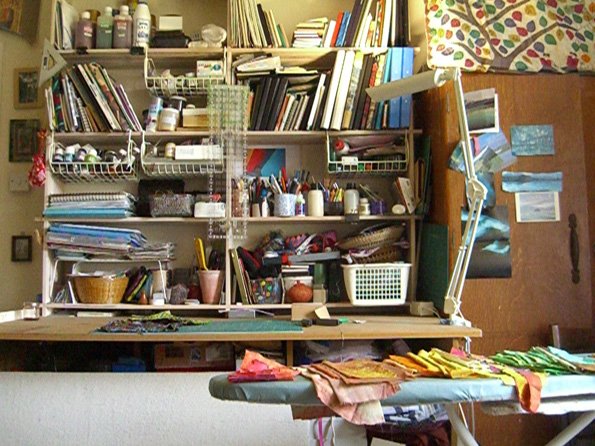
The "workbench" is clear, the shelves are tidier, the lower shelves are hidden by the design board. And fabric for a new project is waiting on the ironing board.

The rest of the room, however, is full of refugee furniture from the living room, which Thomas is painting.

Two steps forward, one step back -- or is it the other way round?

* * * * *
The previous state of the studio, on which this is an improvement, can be seen here - and shows bookshelves that have now been inaccessible for some years. (Too much stuff into too little space...).

But compare the view 11 years ago with the view at the moment -
Gradually the tools are moving to Tom's new tool storage area in his flat over the hill, and this view is set to change in the next week or so. 

06 July 2017

Poetry Thursday - blast from the past

I'll be walking in a different city today, instead of sitting at the computer blogging, so here's something from the early days of Poetry Thursday, July 2014.


Poetry Thursday - Walking in the City by Yvonne Rainer

(via)

Yvonne Rainer: Walking in the City

I can still love this time of day
east from Chelsea
south to St. Marks
a toothless moon
clearing the autumn towers
each aglow in the sun's spent light

As long as I can pass tattoo parlors
palm readers, Greek luncheonettes, bodegas
there may still be room to breathe
in this devouring town

Keep moving

(via)


Born in San Francisco in 1934, Yvonne Rainer [dancer, choreographer, film maker] began training as a modern dancer in her early twenties at the Martha Graham School of Contemporary Dance in New York City. By 1960 she was taking experimental workshops at Merce Cunningham’s nearby studio, where Robert Dunn was applying John Cage’s chance-based compositions to dance. The same year Rainer started choreographing her own work, and by 1962 she and several others had founded the Judson Dance Theatre. Though the troupe had disbanded by 1964, their performances at the progressive Judson Memorial Church in Greenwich Village gave rise to an influential new style that resisted the showy virtuosity of ballet in favor of more commonplace movements, such as walking, running, and speaking. Rainer developed a philosophy of performance that, like the minimalist ethos percolating simultaneously, eschewed hierarchy. No single element—moment, body part, form, person—should appear more important than any other. Moreover, spectacle, which generated detached and unengaged viewers, should be avoided. (source)

Of her Poems (2011), a reviewer said: "the fact that Rainer has been stealthily writing poems can’t be too much of a surprise. She is, famously, an acute observer of behavior and condition. While the physical in her stage work is neighborly with text (sources for the piece at BAC included Rousseau, Lydia Davis, and William James, among others), so it is the other way around in Poems."

05 July 2017

Repotting

This plant arrived as a tiny wee thing about six years ago, and has met with benign neglect every since. It's needed repotting for the past four years or so, and has struggled on. Just look at those roots!
It seems to be a Haworthia, and a care tip is not to water them too much. Possibly I overwatered when repotting? Haworthias do well in lower light conditions, ie not on the sunny windowsill.

Or it could be an aloe? Aloes like more light and water.

Time will tell. I've moved the new pots off the sunny windowsill, just in case.
Too much light? Too many plantlets in each pot?
This one's been settled into its (rather larger) pot for some years, too -
Another haworthia? It does well in sunlight, as long as it gets enough water. So, maybe an aloe?

The more photos I look at on the internet, the more confused I get. I'll go to the library and get a book.

04 July 2017

Drawing Tuesday - V&A 20th century gallery

Sitting on a bench at the side of the room, in low lighting conditions, I spotted "interesting shapes" on a length of fabric in the vitrine - this is a closeup and doesn't show what I saw. I saw the black shapes, and the background - but not the grey, not even from close to!

Once I'd drawn the black shapes I traced a couple and transferred them to the next page, making a pattern repeat (seated on the comfortable bench). Then I went back to the source and re-examined the shapes, getting the proportions more exact ... and discovered the white patterning on the grey background.

The fabric is Trees by Eileen Hunter, 1933. The V&A has several fabrics by Eileen Hunter (some with images on the website). A self-taught textile designer, Eileen Hunter (b.1912) was an ardent campaigner against pale and dreary colours in the 1930s, when most textile designers and manufacturers avoided bright colours. From 1933 to 1939 she ran her own firm in London and marketed her own designs (with outlets in Paris, Amsterdam, New York, and Canada). The fabrics were block printed by Warner & Sons.
I didn't start over in an attempt to re-create the block for this fabric, and some of my shapes suffered from needing to fit onto the page, but enjoyed trying to get the spirit of the piece.
 
 At home I added "a grey layer", experimenting with various intensities of soluble graphite. (The horse is from a plate designed by John Armstrong, part of Clarice Cliff Bizarre Pottery, similar to this one. I'm distressed to discover how many items on display in the museum don't have illustrations in the online catalogue.)
Further development included taking out the lines around the white shapes as much as possible, using an eraser liberally in the areas meant to be white (they got amazingly grey from inadvertent rubbing off from the 7B pencil) and adding black to some of the floating shapes -


Elsewhere...

Michelle stopped on the way to the gallery to draw this Asian sculpture ... something about the expression caught her eye -
 Joyce found a stack of curvaceous drawers -
 Judith took the pattern from a Russian plate -
 Sue lamented that chairs have a way of not quite fitting conveniently onto the page -
 something that Mags found too -
 whereas Carol's chairs were more well-behaved -

Extracurricular activities

Following on from her drawing of the staircase at the Wellcome, Judith used paper shapes and soluble crayons to reinterpret the form -
Mags had been to a weekend workshop that involved binding together various single-sheet folded books with "invisible piano hinges" -

03 July 2017

Crowdfunding May Morris


The William Morris Gallery, just up the road in Walthamstow, is trying to raise £15K to put on an exhibition about the work of May, the talented, skilled, and productive daughter of William Morris.

In 2015, the V&A blogged about her as an "unsung artist" (here).
Embroidery design, c.1885, by May Morris (via)
It's difficult, no doubt, to be the child of a famous parent when you follow in their footsteps. And to be the daughter... well, she could do with a little help to get a little recognition, even a century later.

As is usual in crowdfunding, there are rewards for various amounts of support. Donate £15 and get postcards, £25 a totebag, £45 the totebag and afternoon tea for two, £100 for a silk scarf in her honeysuckle design ... and for £995, a personal tour of Hand & Lock embroidery studios!
(via)
Of course if they don't make the target, your pledge will be useless, and no money is taken from your account.

There's an interesting wrinkle: £5000 has been pledged by a single donor, contingent on the first £10K being raised.

At time of writing, just 12 days remain, and it's about a third funded. If you're a fan of the Arts & Crafts movement and have a bit of cash to spare, have a look atwww.artfund.org/get-involved/art-happens/may-morris

The museum says:
"May Morris was one of the most important figures of the Arts and Crafts movement. A successful designer of wallpaper, jewellery and woven textiles, she was most influential as a pioneer of art embroidery – her work and expertise were in demand across the world. But her achievements have for too long been overshadowed by her more famous father, William Morris. 
We think it’s time May was recognised for her own talents. That’s why we’re asking for your help in raising £15,000 to create May Morris: Art & Life, a major new exhibition of May’s work. If our campaign is successful we can bring together rarely seen embroideries, costumes, jewellery, works on paper and personal items from collections across the country – and display them side by side for the first time."
May Morris in 1909 (aged 47) (via)

Update: The project reached £15,000 funding on 14 July.

02 July 2017

Domestic delights

The great excitement this week has been my son's purchase of a ground floor flat in a building on a corner ... with a turret. It needs some work, and the ambitious new owners have got to work on the interior. My role is in the garden.

Three days later, we were off to building centre to check out paving slabs for the garden and a few other things. It's a vast place -
 with yet more outside, including about 100 types of bricks -
 More fun was the garden centre, getting "a few things" to fill a few pots, just to make the entrance nicer and add some colour to the back garden. And secateurs were needed, and bags of compost. (Doesn't it mount up quickly...)
 The front garden has had the larger weeds removed with a strimmer, but there were still lots of roots to deal with, and much raking out of long weedy grass.
Originally
Before
After - three grey bags of roots, grass, glass, broken bricks, etc.
(The purple bags belong to no-one, it seems; the real estate sign too needs taking away)
 You can just about see the two tiny ferns under the lone window - that spot is in constant shade. There will paving interspersed with plants, and some sort of screening plants near the road, perhaps bamboo or shrubs of the fast-growing sort.

The back garden gets a lot of sun - and had turned into Nettle City -
 The strimmer put that right, and the hideous old bedroom carpet is suppressing what's left -
A nice bench appeared when the nettles were cut down.

Six large plants (some with names unfamiliar to me) are now in pots; let's see how they do -
A good soak before planting
Keep hold of the labels, they're a useful aide memoire


The entrance gets a lot of afternoon sun in the summer, so the plan to brighten the shady door with pots of ferns went out the window, and plants intended for my own garden went into the pots instead ... for now ...

 Another highlight of the day was the transformation of the gas meter boxes from grey to white. Little things make a big difference!


01 July 2017

New shoes (and some art)

New = first time worn, even though they've been sitting around waiting for this moment for about three weeks. Would they be comfortable after a day's walking? (That's 10,000 or more steps, thanks to the gizmo on my wrist and my rather obsessive need to meet that goal every day.)

The new shoes found themselves crossing the bridleway in Hyde Park (not a horse in sight) -
 and pausing here and there at the V&A -
But what is it with feet?? Why, at the end of the day, does one middle-toe on one foot hurt, are feet that asymmetrical?

Since then the feet have carried me, in different shoes, to various art events. Exhibitions at the Photographers' Gallery (eerie and eventually terribly annoying pix taken in a small town in Massachusetts by ...had to look it up ... Gregory Crewdson), and the inspiring Dust exhibition at the Whitechapel (till 3 Sept) - I especially liked Kirk Palmer's video Murmur, and was intrigued by this newspaper cutting from 1950, as the directorship of Kew Gardens changed hands -
Would there be any trees in Kew Gardens in 2000?
Mayfair Arts Weekend offered various talks, and I went to three. First, on Milton Avery, who would go to Vermont for the summer and come back with 200 preliminary works, then spend the winter in his studio turning watercolours into oil paintings, informed also by drawings. (See the slideshow here.) These two  are based on time in Vermont - at a time when Abstract Expressionism was what other artists were doing -
 His simplification of treatment was very satisfying -
 By coincidence that day I also saw the Advanced Textiles show at City Lit, and again it was simplification of treatment that appealed to me -
Work by Yvonne Blackmore

Today's Mayfair Arts Weekend talks were by British coastal landscape artist Jeremy Gardiner, at the Paisnel Gallery - he works on handmade paper in mixed media, using collaged and printed elements, interesting -
 Then to Annely Juda to see Sigrid Holmwood make pigment from woad - it's called Mayan blue and was used by the Aztecs. Making it involves woad and a type of clay. The process involves picking, chopping, boiling, cooling, whisking (aerating), draining - and drying, washing, filtering, drying again ... fortunately she'd brought along some washed and filtered and dried pigment she'd prepared earlier. Heating it was the missing step, only rediscovered recently, that darkened the colour and made the pigment -
The exhibition is called The Peasants Are Revolting and Sigrid's peasant costume incorporates madder dyeing and screenprinting of the skirt with madder and cochineal. The pattern derives from esparto grass plaits traditionally made in Spain and it reappears in some of the paintings (see them here; the catalogue is online here, and the exhibition runs till 7 July).
Some of the woad growing in the gallery was harvested and used to make pigment
 My souvenir books and bag, courtesy of the generosity of the galleries -
Add caption