07 November 2018

Woodblock Wednesday

The production so far - using my old "passing planets" blocks, and a block carved this term, based on my inky zen circles -
A session of printing, between classes - 
before

after - more circles and some overprinting
 The plan is to join those together. But first, laying them out in different ways ("playing" - !), pushing the ideas along -


Limited palette -

Back in class, demonstration of sharpening tools -
 Carol also teaches on a course that combines woodblock printing with book making. Possible formats include a cloth-covered dos-a-dos book with many-layered pages, and a coptic stitched book with prints inside and the blocks used as the covers.Wow.


06 November 2018

Drawing Tuesday - RAF Museum

New signage! Can you identify the planes?*

I sat at a table with a good view of the big flying boat

Shot as a panorama

But try to fit it onto a page!

Jo's plane looks ready for take-off

Janet B drew the flying boat from the viewing gallery

Sue was attracted by the primary colours

Joyce;s Harrier hovers on the page
 Extracurricular activities - Joyce found this book useful -
 and filled a page, one leaf at a time -

*Lancaster bomber, Spitfire, and F-16 is my guess.

05 November 2018

Books in October

 Read this month -

 Pictures een and text dipped into -
 Wish list -


04 November 2018

Anni Albers, weaver and artist

What held my eye at the Anni Albers show at Tate Modern (till 27 January) were the drawings, many reflecting Precolumbian motifs encountered on trips to Mexico as early as 1935-6, after she and her husband had moved from Germany and were working at Black Mountain College.

 She started printmaking in 1963 -
Sometimes the embossing was on metal -
 "Taking a line for a walk"? (Klee was one of her teachers at the Bauhaus) -
This 1970 colour study looks like a random collection of half-triangles ...
 ... but when you look closely you there are larger areas, of grey when combined with orange, of red when combined with grey -
That realisation got me looking for how space emerged in her patterning.

This became a design for Knoll in the mid-70s -
What's the basic unit here - is there one?

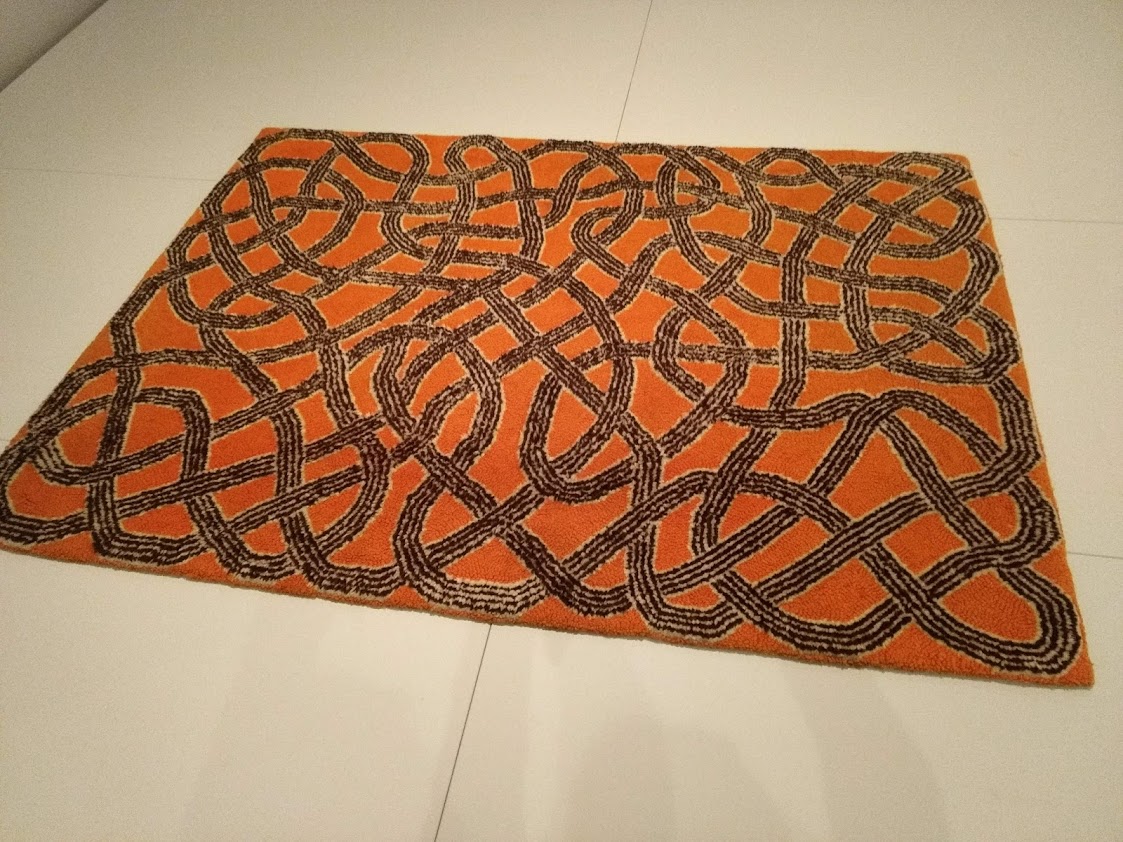
 The drawings of knots, preparatory work for a wonderful rug, are gorgeous -


The room centred on her book On Weaving (1965) had several splendid Precolumbian textiles, dating to approximately 500-1100. Such lovely faded colours, the same as those in a Coptic textile, date 800 perhaps, also displayed -
In the final room were samples of different yarns, and some samples woven with them;  beautiful work by Louise Anderson -
 A chance to experience the "haptic and tactile" qualities of the cloth, and very popular -
The big poster outside the museum has a short and striking summary of the exhibition:
An artist who changed weaving
A weaver who changed art


If textile exhibitions in art museums are of interest, this 2015 article on the Tate website deserves your attention:
Why this fascination now? Is it, as Richard Tuttle once stated, because ‘weaving has a certain cast of the future’?

03 November 2018

Studio Saturday

It's been a short week at the studio. Sometimes, other things get in the way ... and sometimes the energy just isn't there. This week I was concentrating on getting the remaining dipped pots ready for the upcoming stoneware firing, and on catching up with the documentation of those already finished.

Having photographed the most recent pots, I needed to download, crop, adjust colour balance, resize, etc. Somewhat tedious.

After the photos are photoshopped, = they get put onto a page of an Indesign file, in no particular order, and printed -
Then the page gets cut up and pix pasted onto the record sheets. Documentation is complete. 

Looking at these pages (the second one happened by accident, getting slap-happy with the Control+C manoeuvre) I realise that most of my other, previous, over-the-years pots have been individually photographed.

It seems a useful thing to retrieve and gather those pix - which are on the computer rather than "in the cloud" - and resize them so that they make up a "pack of cards" and I can manipulate them into groupings and layouts without being afraid of dropping or bumping the pots themselves.

Or maybe that's too fussy and I should simply get out all the boxes of bubble-wrapped porcelain and sort out what to keep and what to get rid of. There's got to be a point when you do start to get rid of things...

Another plan involving photos, one that's been in my mind for a long time and is at the basis of the entire making process, is to juxtapose the Before (fabric) and After (clay). Perhaps doing that will help me figure out "why" and "where next". (And the "which to keep"...)

Before I start on a new series (aim: a dozen pots with more focus), there are a few more fabric pots hanging around that could be made ready for firing. But some of them are my "complicated" favourites, lots of stitching - they could end up as they are.

No progress with the new kiln - the electrician hasn't come to wire it up yet. After that it needs a test firing and getting to grips with practicalities (such as programming the controller), and then .... well, what then???

First there's this -

In preparation for the Open Studio I'm thinking of what and how to display - which brings us to The Shards. It's getting to the point where I can "let go" of the clunky, boring, chipped, misshapen etc pieces - smash 'em and layer the shards in a jar is the idea. (The idea harks back to the burning-of-work midway through the Book Arts course, when we had an assessment ... that was fun.)

I had some jars (and vases?) on hand
but none were right. The hunt is on, in charity shops. This is the first contender -
A friend said - It looks like a kilner jar - which suggests edibles - is that what you want? The particular shape of a funerary urn suggests things past, memories, broken/dead but not forgotten.... A measuring cylinder would suggest scientific analysis, recording etc   "

Which got me thinking....
Yes it's a kilner jar - which can also suggest preservation, indeed cooking (heat), and exclusion of air (as in tomb).

Where to get a glass funerary urn.......?

I hope the shard become layers - there are some very dark pieces I plan to destroy.

Measuring cylinder also suggests (a) time (to fill it to a certain point); (b) accretion; (c) experimentation of a somewhat scientific sort.
These are the possibilities so far -
As far as the display goes, I'm wondering if some of the groups could sit on grounds of various sorts ... adding an emotional component perhaps ... (again it would be good to have it clear in my head how/why this is meant to work)
 Or maybe the best thing would be to have just the pots themselves, a parade of them across or around the table?

These are ready for firing -
 The space is getting clearer .... the flowers near the window were dipped a couple of weeks ago and are cracking up, is there any point in firing them....

02 November 2018

Things are getting seasonally grouchy again...

Now that the clocks have gone back, and with Hallowe'en out of the way (at last), out comes the tinsel and frills and we're into the C******** season. "Peace on earth and goodwill to men" and you can bet it's the women doing the shopping and cooking and wrapping the presents and writing the cards. Bah humbug.

Good to see that Posy Simmons has been updating that old favourite, Dicken's Christmas Carol, translating Scrooge into Cassandra Darke - read an excerpt here -
(via)
An important part of the seasonal jollification (aka consumerism) is the John Lewis Christmas advert. Perhaps I'm the only person in the UK who hasn't ever - to my knowledge - seen it in years past, but I'm aware of its cultural clout and what a wonderful topic of conversation it is. When will it air? Are the shop's windows a clue to what's in the ad? Oh my ... speculation is rife...

Caveat emptor. Or do I mean Cave canem? No, not that either. Aha, here it is - a thought to hold on to even in the midst of grumpiness and excess, in spite of everything ...

- carpe diem -


01 November 2018

Poetry Thursday - Things by Jorge Luis Borges


Where do poems come from? In this case, Instagram. Sonnets are the perfect length for that medium.
Things
by Jorge Luis Borges (Translated, from the Spanish, by Stephen Kessler)

My cane, my pocket change, this ring of keys,
The obedient lock, the belated notes
The few days left to me will not find time
To read, the deck of cards, the tabletop,
A book, and crushed in its pages the withered
Violet, monument to an afternoon
Undoubtedly unforgettable, now forgotten,
The mirror in the west where a red sunrise
Blazes its illusion. How many things,
Files, doorsills, atlases, wine glasses, nails,
Serve us like slaves who never say a word,
Blind and so mysteriously reserved.
They will endure beyond our vanishing;
And they will never know that we have gone.
(via)


And then there's this one -

Things That Might Have Been
by Jorge Luis Borges (tr. A. S. Kline)

I think of things that weren't, but might have been.
The treatise on Saxon myths Bede never wrote.
The inconceivable work Dante might have had a glimpse of,
As soon as he’d corrected the Comedy’s last verse.
History without the afternoons of the Cross and the hemlock.
History without the face of Helen.
Man without the eyes that gave us the moon.
On Gettysburg’s three days, victory for the South.
The love we never shared.
The wide empire the Vikings chose not to found.
The world without the wheel or the rose.
The view John Donne held of Shakespeare.
The other horn of the Unicorn.
The fabled Irish bird that lights on two trees at once.
The child I never had.


Pienso en las cosas que pudieron ser y no fueron.
El tratado de mitología sajona que Beda no escribió.
La obra inconcebible que a Dante le fue dada acaso entrever,
Ya corregido el último verso de la Comedia.
La historia sin la tarde de la Cruz y la tarde de la cicuta.
La historia sin el rostro de Helena.
El hombre sin los ojos, que nos han deparado la luna.
En las tres jornadas de Gettysburg la victoria del Sur.
El amor que no compartimos.
El dilatado imperio que los Vikings no quisieron fundar.
El orbe sin la rueda o sin la rosa.
El juicio de John Donne sobre Shakespeare.
El otro cuerno del Unicornio.
El ave fabulosa de Irlanda, que está en dos lugares a un tiempo.
El hijo que no tuve.