08 September 2015

Drawing Tuesday - Barkcloth at the British Museum

The Pacific barkcloth exhibition is extended till 6 December. A nice quiet corner of the museum in which to draw. In fact the entire museum felt strangely quiet - but then, we didn't go to the Egyptian parts, which are always busy.
Just one room, but the patterns are addictive.

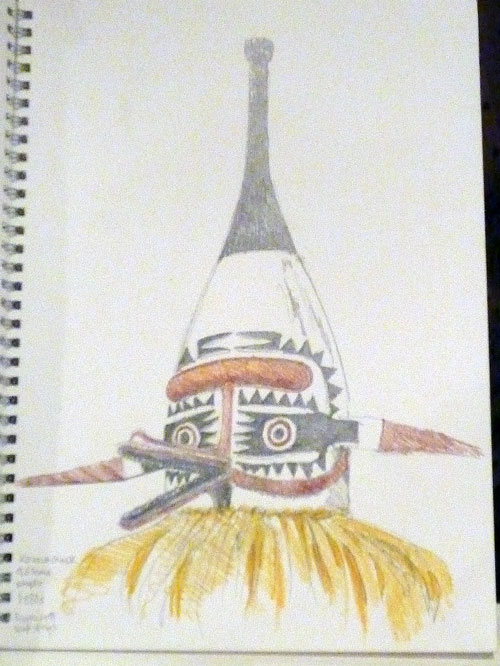
I started with this - it looks like medieval tiles on top, and Elizabethan blackwork below -
 and drew happily, with a propelling pencil, enjoying the "colouring in"-
but there wasn't time to start another - though I would have done something completely different, less orderly, wilder ... like this -
Ah well, next time...

More patterns and objects -
Fine, fine lines...
... and more fine lines
Bold!

A "beard" and a head dress

Cloths that tell stories, and that use indigo

Unfortunately the reflections get in the way
The little guy brings to mind Cousin Itt from the Addams Family

Not just pattern, but fringey shadows
Everyone did many drawings, and these are just some of them ...
Jo's dark, feathered head dress
Front view (Jo), side view (Cathy)...
... and another view (Sue)
Mags had been to the exhibition and had refreshed her memory by printing out photos
- then tackled the patterning overall and in small details
Mags' details of feather head dress 
Cathy tackled one of the cloths with lots and lots of fine lines
This venue needs another visit before the exhibition closes in December.

06 September 2015

What's in a needle?

Having read about them in American sewing magazines, I was interested to see a display of Tulip needles at Festival of Quilts, and had a good conversation with Yuko about them -
She gave me a catalogue and a sample set, which contains a quilting needle, an embroidery needle, an applique needle, and some pins -
Sad to say, I haven't tried them yet - being the sort of person who "takes the nearest" as long as the needle's eye is big enough for the thread and who has needle books and pincushions scattered around the place, and probably a few loose needles and pins too, I rather hope that Proper Needles will not only improve the pleasure of sewing (if that is possible) but might prompt me to be a bit more careful and organised with these tiny, sharp, important objects. (But I'm putting off testing that theory.)

90% of needles produced in Japan are manufactured in the city of Hiroshima. The catalogue tells the history of this industry, which stretches back 300 years. Click on the image(s) to make them large enough to read -
What the discerning craftsman needs in a needle, the catalogue implies, is smooth piercing, "a quality eye that prevents snagging", and a smooth and flexible (but not bendy) body. I can testify to the importance of a smooth eye - buying "value" needles, you often end up with needles that can't even be threaded because the eye is so rough!
Manufacturing starts with stretching the wire straight and cutting to size, then grinding the tip, shaping the head and stamping the eye, grinding off the "ears" produced by the stamping; it goes through stages of hardening, polishing, sharpening the tip, nickel plating, and inspection.

Tulip produces about 50 kinds of needles. Why so many different kinds, I asked Yuko. "People who make different things have their favourite needles and want just those," she replied. Good workers value good tools.

05 September 2015

Passing the time - for 10 minutes

It's not done to stare at people, so I found myself using a new method of blind-drawing during a short underground journey this morning ... taking a "visual bite" and looking away - but not at the paper!

The only paper available was a tiny notebook (50p at Tiger) that was in my tiny handbag.


The final drawing was a matter of looking at the person next to me out of the corner of my eye - tricky when the glasses frames are quite small!

What helps with the looking is that most people are absorbed in looking at their phone. 

04 September 2015

Almost forgotten (miscellany)

Because I have a Big Project that needs doing within the next week, I'm finding all sorts of diversions, amid intense sessions of heads-down work.

One such is to clear out the Downloads file on my computer. (Checked yours lately? It can use up a LOT of disk space!) It had about 1400 files in it, going back to 2011. I'm starting with the oldest and just running my eye through the names in case there's anything interesting...

Found this -
Stitching by Emily Barletta, whose pared-down, striking work soothed my soul. So I had to go over to her site to see what she's up to now ... rather more dynamic work, interesting! Still, the earlier work beckons -
What else? This is the Voynich Manuscript, a mysterious medieval book that I wrote about before -
This is "Truism" by John Squire ... or at least that's what my file name leads me to believe (file names, changed to something useful, can help jog a flailing memory) - 
Lead sheet on board; bought by the Art Fund for the gallery in Oldham
And finally, for it's definitely time to get back to some heads-down, rather than amassing blog posts to be published in days to come, Henry Miller's work schedule - substitute your medium of choice for "writing" -

03 September 2015

Poetry Thursday - Spark Catchers by Lem Sissay

Poetry in situ, Olympic Park, 2015
Near the site of this wooden structure (with its "Danger, high voltage" signs - the transformers that give the power to the entire Olympic site) in Olympic Park once stood the Bryant & May match factory. The poem etched onto it was the first poem commissioned for the park,  ‘Spark Catchers’ written by Lemn Sissay. It remembers the Victorian socialist feminist Annie Besant, who led the Matchgirls Strike in 1888, the first un-unionised strike in British history.

"The incendiary poem plays on the double meaning of the word ‘strike’ and also evokes images of the flame of the Olympic Torch. The matchgirls strike was sparked by the sacking of one of the workers but was ultimately against the 14 hour days, low pay, unfair deductions from wages and the toxic working conditions from the phosphorous used in match making" says Sissay on his blog.
He talks about it in a video made in 2012, before the poem was etched into the structure, and also in a Front Row interview on BBC here (it starts at the 13-minute mark), at a time when surface-to-air missiles were to be situated, as part of the protection for the Olympic site, on the roof of the former factory.
In its pristine glory, 2012 (via)
Other poems are engraved and carved around the Park – Tennyson’s Ulysses outside Chobham Academy, Carol Ann Duffy’s Eton Manor in the north of the Park, Jo Shapcott’s Wild Swimmer along the Park’s waterways, Caroline Bird’s The Fun Palace on the Podium in the south of the Park, and John Burnside’s Bicycling For Ladies near Lee Valley VeloPark.
The Bryant & May factory was redeveloped in the 1980s, one of the first urban renewal projects in the area, and is now part of a gated community.

And now, at last, the poem -

Spark Catchers by Lemn Sissay

Tide twists on the Thames and lifts the Lea to the brim of Bow
Where shoals of sirens work by way of the waves.
At the fire factory the fortress of flames

In tidal shifts East London Lampades made
Millions of matches that lit candles for the well-to-do
And the ne’er-do-well to do alike. Strike.


The greatest threat to their lives was
The sulferuous spite filled spit of diablo
The molten madness of a spark

They became spark catchers and on the word “strike”
a parched arched woman would dive
With hand outstretched to catch the light.

And Land like a crouching tiger with fist high
Holding the malevolent flare tight
‘til it became an ash dot in the palm. Strike.


The women applauded the magnificent grace
The skill it took, the pirouette in mid air
The precision, perfection and the peace.

Beneath stars by the bending bridge of Bow
In the silver sheen of a phosphorous moon
They practised Spark Catching.

“The fist the earth the spark it’s core
The fist the body the spark it’s heart”
The Matchmakers march. Strike.

Lampades The Torch bearers
The Catchers of light.
Sparks fly Matchmakers strike.

(via)

02 September 2015

Colourful playing cards


Last year I was painting the Colour Dictionary, and with a book fair coming up, I wondered how to "capitalise" on this creation ... as if explaining what it is, and maybe "why do this?", wasn't enough to be getting on with during the day. Still, as well as educating the public, the aim of a book fair is to sell books and at least cover your costs, so, what to do that complements or augments the Colour Dictionary?

Feeding into this is the small question of how to set up the table. To keep it simple, I'm thinking of using the dictionary as the centrepiece, in a protective clamshell box that I have yet to make for it, but feel reasonably confident about, having been to a box-making workshop not so long ago. 
Box making workshop with Young Kim at Morley College, July
What sort of colourful (and possibly saleable) book-objects can join it?

Thinking of how to package these objects, whatever they may be (collections of painted sheets of paper?) got me thinking of different types of boxes, including those with book-like proportions ... such as boxes that playing cards come in.

Ah, playing cards ... usually their backs are all the same pattern, but what if each one in the deck had a different colour on the back, or rather, a different shade, closely related shades ... and the colours were randomly distributed ... would other players be able to remember which subtle nuance indicated the ace of spades or the ten of clubs, say?
I found two used decks of cards and painted the backs white, sanded them, and planned to apply colours to both decks at once, to save on paint mixing time - going from blue to purple to red to orange to yellow to green. Without trying it, and remembering the process of painting the dictionary, it seems that six colours doesn't make for a lot of close shades.

In the end (or rather, the beginning...) I painted just one deck, used two colours of blue and two of green, and just kept mixing a bit of something and hoped it would result in 52 different shades.
The excitement was in getting the cards off the newspaper (they were held on by little tubes of masking tape) and laying them out - 
Testing the idea on my drawing group, we all seemed to play with the "colour chips" than to consider the cards as playing cards - a different sort of game -
Can't wait to try other "segues" of colour!

I'm a bit fixated on using old decks of cards, but new ones are probably easier to get, so I'll try a new deck next time that time permits.

01 September 2015

Drawing Tuesday - Ceramics at V&A

One of the delights of the 6th floor ceramics collection is that it's nice and quiet - especially after the busy ground floor of the museum. Another is that there are stools just around the corner as you get out of the lift (turn left after the museum entrance to find the lift). Also, there a various seats along the wall, and this is what I could see from mine -
 Whereas this -
is what I couldn't see, as I was looking sideways on. Take out the shelves and the pots seem to be rising like balloons, or sunken objects filled with air -
The small groupings were where I started, warming up - and thinking about how my fabric/porcelain dipped pots could become installations, groupings.

Then something different - Lawson Oyekan's tall red clay "termite mound" - except it's not, it's from his "Coming Up For Air" series and shows the manner of its building, layers of clay pressed on with fingers and thumbs, the incised with many marks -
 I tackled it with soluble graphite, propelling pencil, indigo pencil crayon, and white pastel, trying to incorporate various types and pressures and speeds of marks, including gestures made from the shoulder  -
As a "picture" of the original, it's all wrong, but as an expressive drawing ... I "like" it.

So many objects to choose from! Here are some chosen (from) by the others -


And here are the drawings -
Jo - water buffalo (and rider) 1750-60

Mags - Chinese ewer with three feet, a mere 3500 years old

Sue - crockery collection (and items in cabinets beyond)

Sue again - we thought the addition of the shelf was a great touch

Cathy - how do you make white shapes look 3D? Other pots are by Lucie Rie

Janet - the curves of a bone china shell, no.1 in a limited edition of 5, Wedgwood
The V&A has a nice timeline of "masterpieces of ceramics" here.